Blog
Centre Table Designs for Small Living Rooms: What Works Best?


In a small living room, the centre table has a tricky job. It has to hold chai, the remote and the occasional laptop, give guests somewhere to put their cups, and still leave enough floor to walk. Choose one that’s too big and the room feels like an obstacle course. Choose one that’s too small and nobody has anywhere to put a plate.
The good news is that a handful of designs solve this problem well. This guide walks through them, with real sizes, simple rules for fitting a table to your sofa and room, and a few mistakes that are easy to avoid. The examples come from our sheesham range.
The quick answer
| If your room is… | Table to look at | Why |
|---|---|---|
| Very tight | Solid Wood Wood Coffee Table with Drawers | No corners, and nesting tables shrink when you need floor space |
| Short on storage | Solid Wood Rattan Coffee Table | Hides remotes, magazines and chargers |
| Used for guests often | Solid Wood Coffee Table with Tiles | Extra seating tucks underneath |
| Modern and minimal | Solid Wood Coffee Table with Brass Inlay and Cane Weaving | Clean lines take up less visual space |
| Traditional or boho | Solid Wood Noir Coffee Table | Adds character without heavy bulk |
If you remember just one thing: in a small room, the table should leave at least 18 inches between itself and the sofa, and a clear walkway of 24 to 30 inches around the rest.
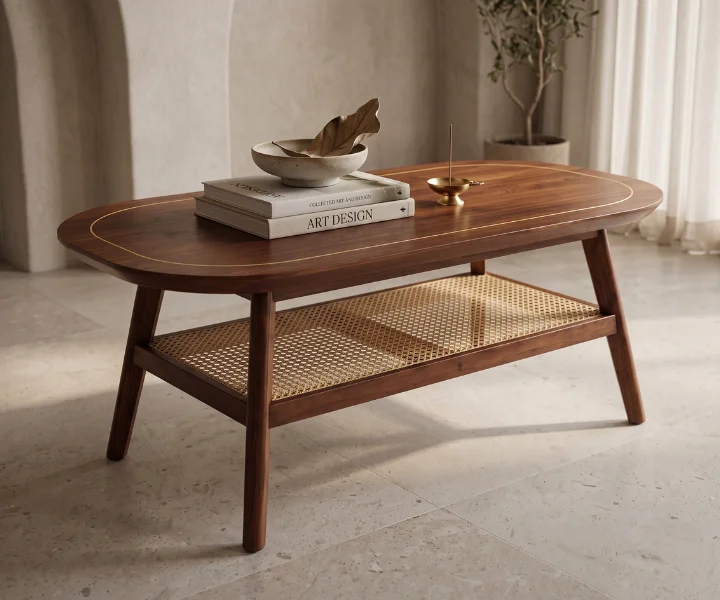
Sheesham Wood Coffee Table with Brass Inlay and Cane Weaving
How big should a centre table be?
You don’t need a tape measure obsession. Three simple checks cover it.
1. Height: about the same as your sofa seat
A good centre table is roughly the same height as your sofa seat, or a couple of inches lower. For most sofas, that means about 16 to 18 inches. Our Noir Coffee Table, for example, is listed at a 17 inch table height, which is right in that range. If the table is much taller than the seat, it feels like a barrier. If it’s too low, you’ll be bending awkwardly to reach your tea.
2. Length: around two-thirds of the sofa
A table that’s about two-thirds the length of your sofa looks balanced. A typical three-seater is 72 to 87 inches long, so a table around 40 to 50 inches long suits it. For a two-seater of about 55 to 60 inches, aim for 30 to 38 inches.
3. Distance from the sofa: 16 to 18 inches
Leave 16 to 18 inches between the sofa edge and the table. That’s close enough to reach your cup and far enough to get your legs through. Then check the walkway around the table, which should be at least 24 inches, or 30 inches if it’s a main path through the room.
Typical table sizes
| Table type | Typical size | Good for |
|---|---|---|
| Small round | 24 to 30 in across | Very small rooms, beside a sofa |
| Medium round or oval | 30 to 36 in across | Small living rooms, shared seating |
| Slim rectangular | 36 to 42 × 18 to 22 in | Narrow rooms, apartment sofas |
| Standard rectangular | 42 to 48 × 20 to 26 in | Small to medium rooms |
| Nesting set | Varies by piece | Flexible spaces |
These are typical ranges, so always check the exact measurements in the listing.
The best centre table designs for small rooms
1. Round tables
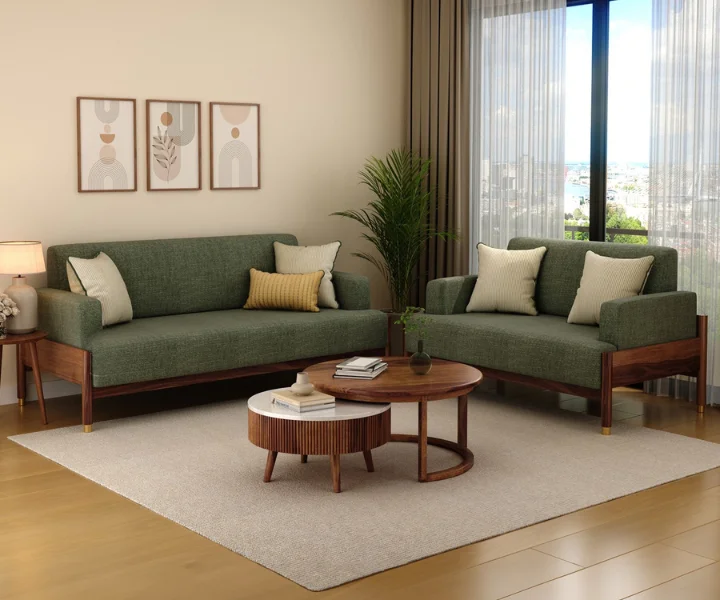
A round table is often the smartest choice for a small room. It has no corners to bump into, it fits snugly in tight spaces and it softens a room full of straight lines. People can squeeze past it more easily, which matters if your living room is also a hallway.
Our Noir Coffee Table is a good example. It’s round, made of sheesham with a teak finish, and has storage for books and newspapers. The listed size is about 28.65 by 21.75 by 15 inches, with a table height of 17 inches, which keeps it compact. It’s also listed with a 12-month warranty and no assembly required.
Good for: small rooms, homes with children, tight walkways.
Watch for: a very small round top can’t hold much, so check the surface area.
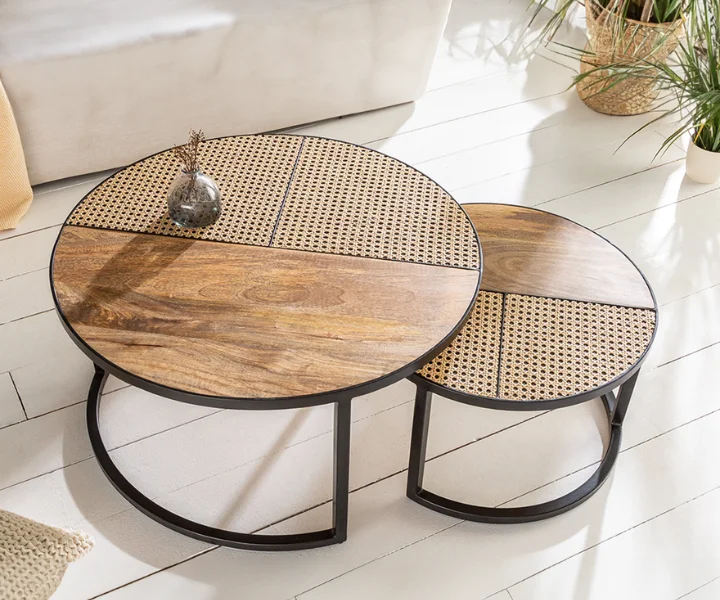
Stella Round Wooden Nesting Coffee Table
2. Nesting tables
A nesting set is two or three tables of different sizes that slide into each other. When you’re alone, they stay compact. When guests arrive, you pull them apart and suddenly you have three surfaces. They’re perfect for living rooms that change roles during the day.
Good for: flats, rented homes, anyone who entertains occasionally.
Watch for: the smaller tables can feel light, so choose solid wood for stability.
3. Tables with storage
A shelf underneath or a small drawer does a lot in a small room. Remotes, magazines, coasters and chargers all disappear, which keeps the top clear and the room tidy. Many of our designs, like the Noir, include storage for exactly this reason.
Good for: homes with little other storage, anyone who dislikes clutter.
Watch for: drawers and shelves add height and weight, so check the size and make sure the table doesn’t look bulky.
4. Tables with pouf stools underneath
Some designs tuck two or three stools or cushioned poufs under the tabletop. They give you extra seating when guests visit and vanish when you don’t need them. It’s a clever answer to a small living room with too few seats.
Good for: families who host, rooms with a small sofa.
Watch for: check that the stools fit comfortably underneath, and that the table height suits sitting on them.
5. Lift-top tables
The top of a lift-top table rises up and forward to become a laptop desk or a dining surface. It’s useful if your living room doubles as a workspace.
Good for: working from home, snacking on the sofa.
Watch for: the mechanism needs to feel solid, and cheap ones can wobble or jam.
6. Slim rectangular tables
A long, slim table follows the line of the sofa without taking up much depth. It suits narrow rooms and modern interiors, where straight lines look neat.
Good for: narrow living rooms, minimalist styles.
Watch for: the surface is smaller, so it holds less.
7. Low platform tables
A low table sits closer to the floor and makes a room feel taller and more open. It suits Japandi and relaxed modern interiors, especially with low sofas.
Good for: low-profile seating, modern rooms.
Watch for: it can be hard to use for eating or laptop work, so decide how you’ll use it.
8. Cane and brass-inlay tables
Texture adds character without adding bulk. Our Sheesham Wood Coffee Table with Brass Inlay and Cane Weaving mixes solid wood with woven cane and brass detail, and it suits modern, boho, Scandinavian and mid-century interiors. The Selena Solid Sheesham Wood Cane Coffee Table is another cane option, listed at ₹19,599.
Good for: adding personality to a plain room.
Watch for: cane needs gentle cleaning, and shouldn’t be soaked or scrubbed.
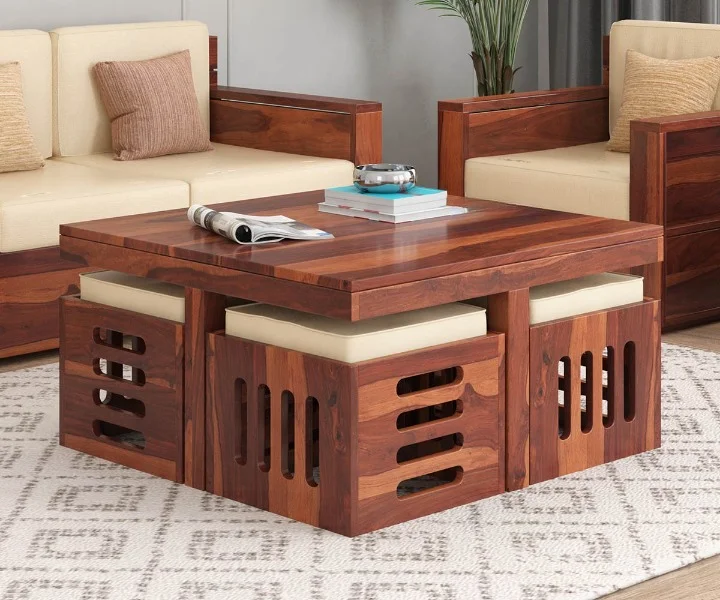
Ivy Solid Wood Coffee Table Sets
One table or two small ones?
In a small living room, two small tables sometimes work better than one big one. Two small round tables, one beside each end of the sofa, let you place drinks within reach without blocking the middle. They’re also easier to move around.
A single table suits a neat, centred look. Two tables suit a flexible, casual one. If your sofa is an L-shape, a single round table near the corner often works best, or an ottoman-style piece that doubles as seating.
Shape matters: which suits your room?
| Room shape | Best table shape |
|---|---|
| Narrow rectangle | Slim rectangular or oval |
| Square | Round or square |
| Lots of foot traffic | Round or oval |
| L-shaped sofa | Round, or a square table in the corner |
| Open plan | Any shape that defines the seating area, with a rug |
Wood, glass or something else?
Solid wood
Solid wood is durable, warm and repairable. It handles weight, and scratches can be sanded and refinished. Sheesham is dense and takes finishes well. Our honest guide to solid sheesham wood furniture explains how it behaves over time. The main downside is visual weight, so choose lighter finishes and slim legs in a small room.
Glass tops
Glass looks light and lets you see the floor, which helps a small room feel bigger. But it shows fingerprints and dust, it can chip, and it feels cold. If you have young children, think about safety.
Wood with metal
Metal legs or details give a slimmer, more modern look. Check that the piece feels stable.
Light or dark?
Light and honey finishes make a small room feel open, and darker walnut gives contrast and hides marks. Match the table to your sofa and floor, and keep the wood tones in the same family. Our guide to light vs dark wood tables explains the trade-offs.
Styling a centre table without clutter
A small table can look messy fast. A few simple habits help.
- Use a tray. It groups small things, like coasters, candles and remotes, into one neat unit.
- Follow the rule of three. A small plant, a candle and a book make a pleasing group.
- Vary the height. Combine something tall with something low.
- Keep the surface at least half clear, so there’s still space for cups.
- Rotate seasonal pieces. A brass urli or flowers at festival time, something simpler the rest of the year.
- Hide the rest. Use the shelf or drawer for everything else.
If you’re also thinking about your TV wall or sofa, our TV unit, wooden sofa sets and living storage collection all go together with a wooden centre table.
What does a centre table cost?
Prices vary with size, design and materials. On our site, coffee and centre tables sit across a wide range, from compact round tables to larger cane and brass-inlay pieces. The Selena Cane Coffee Table, for example, is listed at ₹19,599 at the time of writing. Prices change with sales, so check the product page for current figures, and browse our tables collection for the full range.
A rough guide: smaller, simpler tables cost less, and larger or more detailed designs with cane, brass or storage cost more. Whatever you pick, compare tables of a similar size and material.
Where to place it
- Centre it on the seating group, and keep it closer to the sofa than to the TV.
- Put a rug underneath, so the table and sofa front legs sit on the same rug. It anchors the group and makes the room feel intentional.
- Keep the path clear. Don’t block the route from the door to the other rooms.
- Check the door swing and any nearby cupboard doors.
- Test with tape. Mark the outline on the floor for a day, then walk around it.
Caring for a wooden centre table
- Dust with a soft dry cloth.
- Wipe spills straight away with a barely damp cloth, then dry.
- Use coasters for hot cups and wet glasses.
- Avoid harsh cleaners and abrasive scrubbers.
- Keep it out of strong direct sun.
- Polish lightly a few times a year.
- Check the screws and legs twice a year.
Mistakes to avoid
- Choosing a table that’s too big. It’s the most common mistake in small rooms.
- Ignoring the height. A table well above or below the seat height is awkward.
- Forgetting the walkway. Leave at least 24 inches around.
- Skipping storage. A tidy surface needs somewhere to put things.
- Buying for looks alone. Check the build and stability.
- Choosing glass with small children around.
- Placing the table too far from the sofa. You’ll stretch for every cup.
- Forgetting the doorway. Measure before you order.
A quick buying checklist
- Measure the sofa length and seat height.
- Aim for a table about two-thirds the sofa length, and the same height as the seat.
- Leave 16 to 18 inches to the sofa and 24 to 30 inches of walkway.
- Decide on a shape: round for tight rooms, rectangular for narrow ones.
- Decide whether you need storage, nesting or extra seating.
- Check the material and the build.
- Confirm assembly, warranty and delivery.
- Check the current price on the product page.
Frequently asked questions
What is the best centre table for a small living room?
A round table, a nesting set or a compact table with storage usually works best. Choose by how you use the room: round for tight spaces, nesting for flexibility, storage for tidiness.
How big should a centre table be?
Around two-thirds the length of your sofa, and about the same height as the seat, usually 16 to 18 inches. Leave 16 to 18 inches between the table and the sofa.
Is a round or rectangular table better for a small room?
Round is usually better, because it has no corners and is easier to walk around. Rectangular works in narrow rooms.
Do I need a centre table at all?
Not always. In a very small room, you can use two small side tables or a pouf instead, which leaves more floor open.
What height should a centre table be?
About the same height as your sofa seat, or one to two inches lower, which is usually 16 to 18 inches.
Are wooden centre tables heavy?
Solid wood is heavier than lighter alternatives, but that weight gives stability. Choose slim legs and lighter finishes to keep the room feeling open.
Is sheesham good for a centre table?
Yes. It’s dense and strong, takes finishes well and can be refinished. Like any wood, it needs protection from heat, water and strong sun.
How do I stop a small centre table looking cluttered?
Use a tray, keep the surface at least half clear and put everything else in the shelf or drawer.
For more info, contact: support@gadwalfurniture.com
Follow our Instagram : Gadwal Furniture