Blog
TV Table Buying Guide: Best Designs for Indian Homes

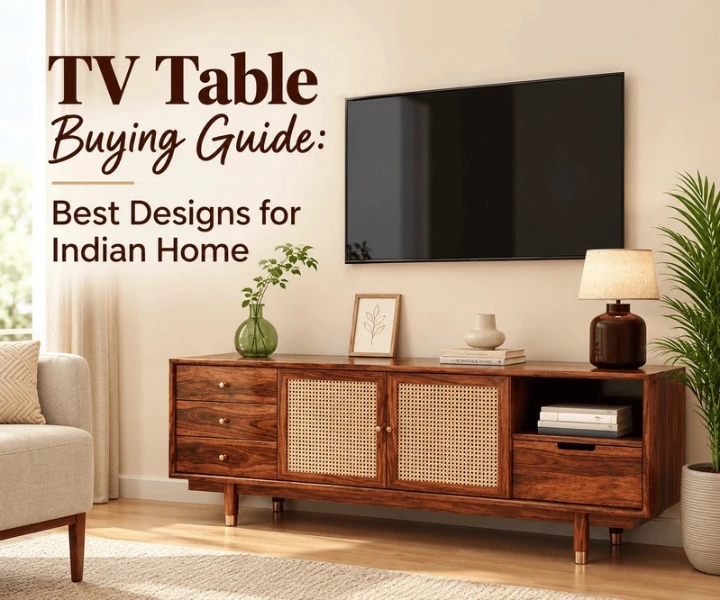
A TV table looks like the simplest piece of furniture in the house. It holds a television, and that’s about it. Then you try to buy one and the questions pile up. Does it need to be wider than the TV? How high should it sit? What about the set-top box, the router, the speakers and the tangle of wires behind it all? And how do you stop a heavy unit from swallowing a small living room?
This guide answers those questions with Indian homes in mind: compact flats, humid summers, dust, and families who actually use the living room. It covers the main designs, how to size a unit to your TV, what to check in the build, and how to choose between floor-standing and wall-mounted options. The examples use solid sheesham wood, which is a popular material for TV units in India.
The short answer
- Width: the unit should be at least as wide as your TV, and ideally a little wider.
- Height: the middle of the screen should sit roughly at eye level when you’re seated, usually around 40 to 42 inches from the floor.
- Storage: match it to what you actually own. Open shelves for devices, closed cabinets for clutter.
- Material: solid wood lasts longer and handles heat, humidity and weight better than thin engineered board.
- Small rooms: a wall-mounted or low floor unit usually works best.
Start with the TV, not the furniture
Most people choose the TV unit first and then wonder why the TV looks too big or too small on it. Work in the other order.
Know your TV’s real width
A TV’s size is measured diagonally, but what matters for furniture is the width. For a standard 16:9 screen, the width is roughly 87% of the diagonal. These are approximate figures, and your TV’s spec sheet has the exact number.
| TV size | Approximate width |
|---|---|
| 43 inch | 37.5 inches |
| 50 inch | 43.5 inches |
| 55 inch | 48 inches |
| 65 inch | 57 inches |
| 75 inch | 65 inches |
Check the stand too. Many TVs sit on two feet at the far edges, so the stand spread can be wider than you expect. Measure that, because it decides whether the TV fits on a shorter unit.
Pick a unit that’s wider than the screen
A TV on a unit that’s narrower than the screen looks unstable, and it often is. As a rule, choose a TV table at least as wide as the TV, with a few extra inches on each side. A 55-inch TV about 48 inches wide sits comfortably on a unit of 55 to 60 inches. That also leaves space for a speaker, a plant or a small decor piece.
Think about viewing distance
How far you sit from the TV affects the size you should buy, which in turn affects the unit. For many modern TVs, a distance of roughly 1.2 to 1.6 times the screen diagonal feels comfortable. For a 55-inch TV, that’s about 5.5 to 7.5 feet. In a small living room, a very large TV on a deep, bulky unit can overwhelm the space, so size everything together.
The main TV unit designs
Floor-standing TV unit
This is the classic choice: a low cabinet or console that sits on the floor, with the TV on top. It’s practical, because it holds the TV’s weight on its own, gives you storage below and doesn’t depend on your wall. It’s also easy to move if you rearrange the room.
Good for: most living rooms, rented flats where you don’t want to drill, and anyone who wants storage.
Watch for: depth. A deep unit eats floor space, so in a compact room, check the measurements carefully.
Wall-mounted TV unit
A wall-mounted design keeps the floor clear, which makes a small room feel larger and easier to clean. Some units have the TV mounted on a panel with shelves or cabinets attached to the wall, while others are floating shelves.
The Ource Wooden Wall Mount TV Unit on our site, for example, is listed at 59 by 12 by 59 inches, with a drawer and closed storage. You can see it on its product page.
Good for: small rooms, modern interiors and people who want a clean look.
Watch for: the wall. It must be strong enough, usually brick or concrete, and it’s better to have the fitting done by a professional. Wall units also need the wiring planned in advance.
TV cabinet with storage
A TV cabinet combines a surface with closed doors, drawers and sometimes open shelves. It hides clutter such as remotes, game controllers, cables, board games and chargers.
The Melvina Sheesham Wood TV Unit is a good example, with cupboards, drawers and shelves in one piece.
Good for: families, homes without much other storage, and anyone who dislikes visible clutter.
Watch for: ventilation. Closed cabinets trap heat from set-top boxes and consoles, so check there’s airflow at the back.
Open-shelf TV unit
Open shelves display decor, books and speakers, and they keep devices easy to reach. They look lighter than closed cabinets, which helps in a small room.
Good for: people who like to display things, and for devices that need airflow.
Watch for: dust and tidiness. Open shelves show everything, so you’ll need to dust more often and keep cables in order.
Low console or media bench
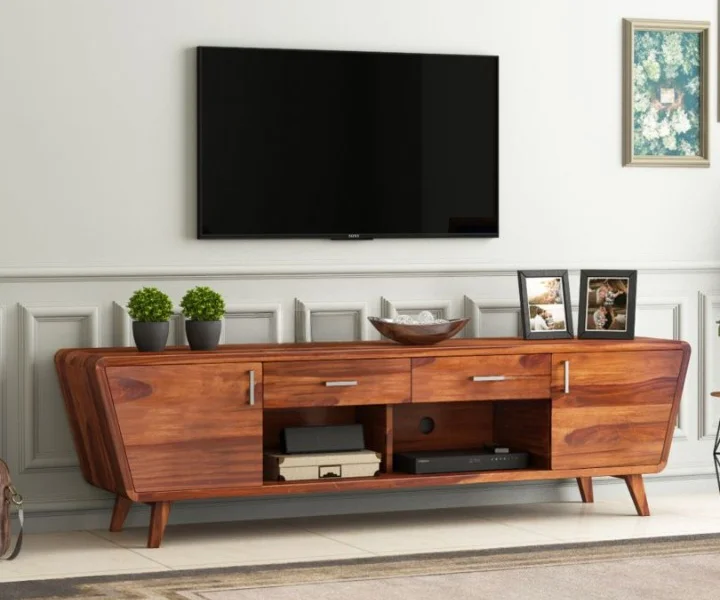
A long, low unit sits well under a wall-mounted TV or a large screen, and it suits modern and minimalist rooms. Some have just two or three drawers or doors.
Good for: wide walls, and rooms where you want the TV to sit low.
Watch for: it can look too long and heavy in a short wall, so measure the space.
Cane and tile-detail units
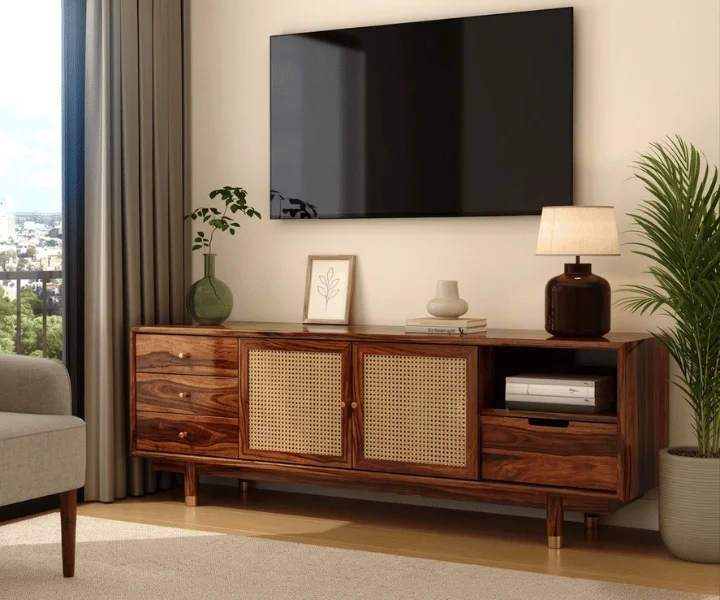
Rattan or cane doors give a lighter, textured look, and they allow some airflow, which helps with devices. Decorative tile details add colour. The Boho Sheesham Wood TV Cabinet with Ceramic Tiles and Storage, listed at ₹22,399 on our site, and the Peter Sheesham Wood Cane TV Cabinet are examples. Browse more in our living storage collection.
Good for: a boho, traditional or relaxed look.
Watch for: cane needs gentle cleaning, and tile details can be a bit more delicate.
Quick comparison
| Type | Best for | Storage | Floor space | Needs wall work |
|---|---|---|---|---|
| Floor-standing | Most homes | Medium to high | Uses floor | No |
| Wall-mounted | Small rooms | Low to medium | Saves floor | Yes |
| Cabinet with storage | Families | High | Uses floor | No |
| Open shelf | Display, devices | Medium | Uses floor | No |
| Low console | Wide walls | Low to medium | Uses floor | No |
| Cane or tile detail | Boho, traditional | Medium | Uses floor | No |
Choosing by room and household
Small living room or flat
Go for a wall-mounted unit or a shallow floor unit with a slim profile. Light colours and open shelves help the room feel bigger. Avoid very deep or very tall units, and choose a design with legs so you can see the floor beneath.
Joint family or busy living room
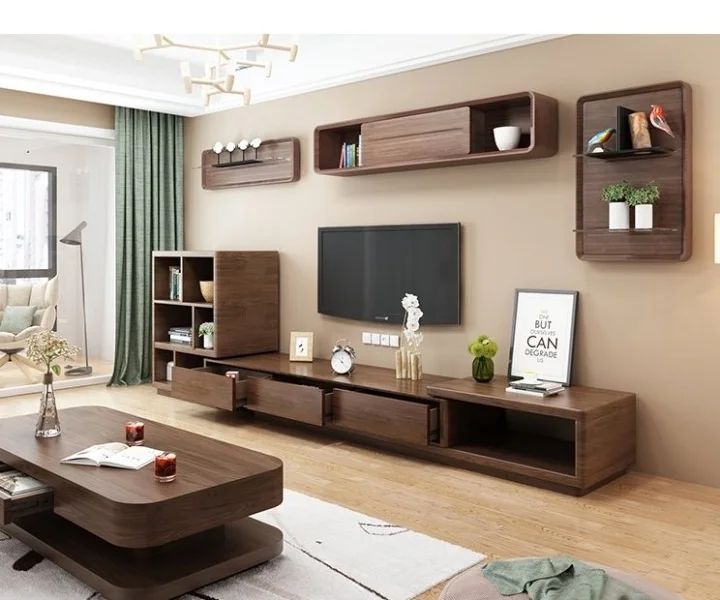
Prioritise storage and durability. A cabinet with drawers and doors keeps remotes, chargers and games out of sight, and a solid top will cope with daily use.
Bedroom
A TV in the bedroom usually calls for a smaller unit, around 36 to 48 inches wide. A low console or wall-mounted unit keeps the room open. Our bedroom collection has pieces that go with it.
Rented home
Choose a floor-standing unit so you can take it with you. Wall-mounted options are harder to move, and many landlords don’t allow drilling.
Home with kids or pets
Pick a stable unit with rounded edges and a heavy base, and avoid anything that tips easily. Anchoring the unit or the TV to the wall is a sensible safety step, since TVs falling on children is a real risk.
What to check in the build
A TV unit carries a heavy, expensive screen, so the build quality matters more than it seems.
Material
Solid wood is the best choice for strength and longevity. Sheesham is dense and stable, and it takes finishes well. Engineered board is cheaper, but it can sag under weight and swell in humid months. Our honest guide to solid sheesham wood furniture covers how it holds up in practice.
Weight capacity
Check what the top surface can hold. A modern TV isn’t very heavy, but add a soundbar, a plant and a few decor pieces, and the load adds up. Ask the maker for a safe weight, and avoid very thin tops for large TVs.
Joinery and stability
Push gently on the corners and the top. The unit shouldn’t wobble or creak. Good joints and a solid back panel keep it stable over the years.
Drawers and doors
Open and close each one. Drawers should slide smoothly and sit square, and doors should close without catching. Cheap hinges and runners are the first things to fail.
Cable management and ventilation
Look for holes or gaps at the back for cables, so wires don’t hang in a tangle. Also check there’s airflow around devices. Set-top boxes, routers and consoles give off heat, and a sealed compartment can cause overheating.
Finish
Honey and light finishes feel warm and open, and they hide dust better. Walnut and darker tones look rich but show dust and fingerprints. Check the finish in daylight, because showroom lighting can change the colour.
Setting up the TV
Height
For comfortable viewing, the middle of the screen should sit about at eye level when you’re seated. For most sofas, that’s around 40 to 42 inches from the floor. If your unit is low, a wall-mounted TV above it or a taller stand can fix the height. A TV that’s too high strains the neck, and one that’s too low is awkward.
Position and glare
Place the TV where sunlight from windows won’t reflect on the screen. If the only wall available faces a window, use curtains or blinds to cut the glare during the day.
Power points and wiring
Plan the wiring before you buy. Check where the sockets are, how many devices you need to plug in, and whether you’ll need an extension board. For wall-mounted units, ask an electrician to run the wires neatly, ideally inside the wall.
The rest of the room
Leave enough space for people to walk past the unit and for doors and windows to open. Keep the unit away from direct heat sources and wet areas.
Care and maintenance
A TV unit sits in a busy part of the home, so a bit of care keeps it looking good.
- Dust weekly with a soft dry cloth, and use a soft brush for carved or cane areas.
- Wipe marks gently with a barely damp cloth, and dry the surface straight away.
- Avoid harsh cleaners, because they can damage the finish.
- Use coasters or mats for drinks and decor, since heat and moisture mark wood.
- Keep the back clear so heat can escape and dust doesn’t collect.
- In the monsoon, let air move around the unit and wipe away any damp patches.
- Check the fittings twice a year, and tighten loose screws.
How much does a TV unit cost?
Prices vary widely with size, wood, finish and design. On our site, listed prices for sheesham TV cabinets start in the low ₹20,000s, such as the Boho TV cabinet at ₹22,399, with larger or more detailed units costing more. If you want a complete look, some of our living room sets include a matching TV unit, centre table and sofa, like our wooden sofa set, which comes with a matching TV unit. Prices change with sales, so check the product pages for current figures.
When comparing units, look at the same size and the same material. A cheap unit in thin engineered board and a solid sheesham one aren’t equal, even if the sizes match.
Common mistakes to avoid
- Buying a unit narrower than the TV. It looks unstable and can tip.
- Ignoring depth. A deep unit can overwhelm a small room.
- Forgetting ventilation. Sealed compartments overheat devices.
- Skipping cable planning. Loose wires look messy and are a trip hazard.
- Choosing by looks alone. Check the build and the weight capacity.
- Placing the TV too high. It strains the neck over time.
- Not measuring the wall and the doorway. A large unit has to fit through your entrance.
- Ignoring safety around children. Anchor the TV and the unit.
A buyer’s checklist
- Measure your TV’s width, including the stand spread.
- Measure the wall and the space around it.
- Decide on floor-standing or wall-mounted.
- List the devices you need to store.
- Choose open or closed storage, or a mix.
- Check the material, joinery and weight capacity.
- Look for cable holes and ventilation.
- Match the finish to your furniture and room.
- Confirm the warranty, delivery and assembly details.
- Check current prices on the product page.
FAQs
What size TV unit do I need for a 55-inch TV?
A 55-inch TV is about 48 inches wide, so choose a unit of about 55 to 60 inches. It should be at least as wide as the TV, with a few inches to spare on each side.
How high should a TV table be?
The middle of the screen should sit roughly at eye level when you’re seated, around 40 to 42 inches from the floor. A low unit works if the TV is slightly taller or wall-mounted above it.
Is a wall-mounted TV unit better than a floor-standing one?
It depends on the room. Wall-mounted units save floor space and suit small rooms, but they need a strong wall and professional fitting. Floor-standing units are simpler, easier to move and usually offer more storage.
Is solid wood good for a TV unit?
Yes. It’s strong, handles weight well and lasts for years. Sheesham is a popular choice in India, though it still pays to keep it out of damp spots and wipe up spills quickly.
Can I put a TV on any table?
It’s better not to. A TV needs a stable, level surface that’s wide enough and strong enough for the weight. A regular side table can tip or sag.
Do TV units need ventilation?
Yes, especially if you keep a set-top box, console or router inside. Choose a unit with open backs or gaps, or leave doors open when the devices are on.
How do I hide the cables on a TV unit?
Pick a unit with holes at the back, use cable clips or sleeves, and keep the extension board out of sight. For wall-mounted TVs, an electrician can run the wires inside the wall.
What is the best TV unit for a small living room?
A wall-mounted or shallow, low floor unit in a light finish usually works best. It saves space and keeps the room feeling open.
For more info, contact: support@gadwalfurniture.com
Follow our Instagram : Gadwal Furniture