Blog
Which Direction Should Your Bed Face in a Small Room?

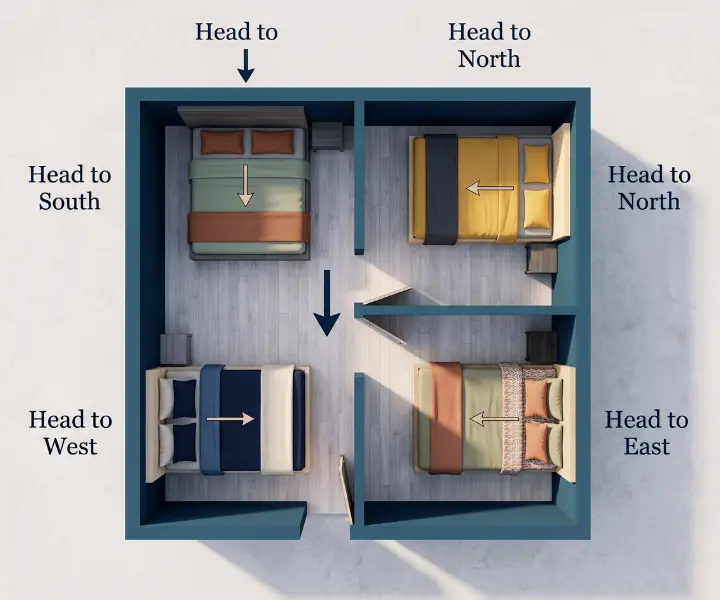
Ask five people which way a bed should face and you’ll probably get five answers. One will say head to the south, another will mention the door, a third will point at the window, and someone’s grandmother will have a firm opinion based on what her mother told her. In a small room, the question gets harder, because there are usually only one or two places the bed can actually go.
This guide covers both sides of the question. First, what traditional Vastu Shastra suggests about bed direction. Second, the practical factors, like doors, windows, light and airflow, that decide what works in a compact room. In most small rooms the best answer is a mix of the two, and the guide shows how to find it.
The short answer
- Traditional Vastu advice: sleep with your head towards the south (most recommended) or east. West is acceptable. Avoid head towards the north.
- Practical advice: keep the headboard against a solid wall, avoid placing the bed directly in line with the door, and leave enough clear space to walk around it.
- For a small room: pick the position that fits the room’s layout first, then adjust the direction if you can do so without cramping the space.
If your room only allows one layout, don’t worry too much. A comfortable, well-ventilated and uncluttered bed matters more for sleep than a compass reading.
Where this advice comes from
Direction advice for beds comes mainly from two traditions: Vastu Shastra in India and Feng Shui in China. Both are old systems of arranging homes, and they overlap in places and disagree in others. People follow them for cultural, spiritual or personal reasons, and many find them a useful framework for planning a room.
It’s worth being honest about one thing. There’s no solid scientific evidence that the direction your head points affects your health or luck. Some explanations mention the earth’s magnetic field, but studies haven’t shown a reliable effect on sleep. That doesn’t mean the advice is useless. A layout that follows these rules tends to put the bed away from the door and against a solid wall, which many people find more restful. If the traditions matter to you, follow them. If you’re mostly after a good night’s sleep, treat them as one input among several.
What Vastu suggests for bed direction
Here’s the usual guidance, with the caveat that practitioners differ on details.
South: the most recommended
Most Vastu sources recommend sleeping with your head towards the south. The traditional reasoning is that it’s a stable, grounding direction, and it’s often suggested for adults and for the master bedroom. If your room allows it, this is the default choice.
East: also considered good
Head towards the east is widely seen as favourable, especially for students and children. It’s linked with the rising sun and with fresh energy, and it’s a common choice when the south isn’t possible.
West: acceptable
Head towards the west is generally considered fine, though less ideal than south or east. If it’s the only layout that works in a small room, you don’t need to worry.
North: usually avoided
Most Vastu advice discourages sleeping with your head towards the north. Some sources link this to poor sleep or restlessness. If your bed has to face north, many practitioners suggest shifting it a few degrees or simply choosing another wall if you can.
Which direction for which person
| Person | Commonly suggested direction |
|---|---|
| Adults, master bedroom | South, or east |
| Children and students | East, or west |
| Elders | South, or west |
| Guests | Any comfortable direction, often west or north-west |
Some sources give different advice for different family members, so if this matters to you, it’s worth checking with a Vastu consultant you trust.
What matters just as much in a small room
For a compact room, practical factors often decide where the bed can go. Think about these before you commit to a direction.
The door
Many traditions, and plenty of common sense, suggest avoiding a bed that sits directly in line with the door, especially with your feet pointing at it. Part of this is tradition, and part is that it feels more private and secure to have the bed slightly off to the side, where people walking in don’t see you straight away.
In a small room, you may not be able to avoid it completely. If so, shift the bed a little sideways, add a headboard or a low bench at the foot, or use a curtain or screen to soften the line of sight.
The window
Beds under a window are common in small rooms, since there’s no other wall free. It works, but there are trade-offs:
- Light and noise from outside reach you more easily.
- In winter, the area can feel cold, and in summer, the sun can heat the bed.
- A tall headboard may block the window.
If you have to place the bed under a window, use thick curtains or blinds, and pick a lower headboard so it doesn’t block the light. If you have a choice, keep the headboard on a solid wall and put the window to the side.
The headboard wall
A bed feels more settled with its headboard against a solid wall. It stops the bed from drifting, makes the room look more stable and gives you something to lean on while reading. Avoid putting the head of the bed against a wall that has a door on the other side, or one that shares a wall with a noisy bathroom or kitchen, if you can help it.
Airflow and fans
In India, the position of the fan or air conditioner matters. A fan blowing directly on your face all night can be uncomfortable, and an AC aimed straight at the bed can leave you cold or dry-throated. Place the bed so air circulates across the room and not straight onto you.
Beams, mirrors and clutter
Traditional advice says to avoid sleeping under an exposed beam, and to avoid a mirror that reflects the bed. Practically, a heavy beam can feel oppressive, and a mirror that catches your reflection in the dark can be unsettling. If you can’t move either, a false ceiling panel or a cover for the mirror at night is an easy fix.
Layouts that work in a small room
Small rooms limit your choices, so here are the layouts that tend to work best. Measurements assume a double bed of roughly 4.5 by 6.25 feet.
Bed against the long wall
This keeps the centre of the room open and leaves a clear path along one side. It’s useful in narrow rooms, though you may need to leave one side against the wall, which makes the bed harder to make and means one person climbs in over the other.
Bed in the corner
Pushing the bed into a corner gives you the most floor space. The trade-off is the same as above: access from only one side. It suits a single bed or a child’s room better than a couple’s room.
Bed centred on the short wall
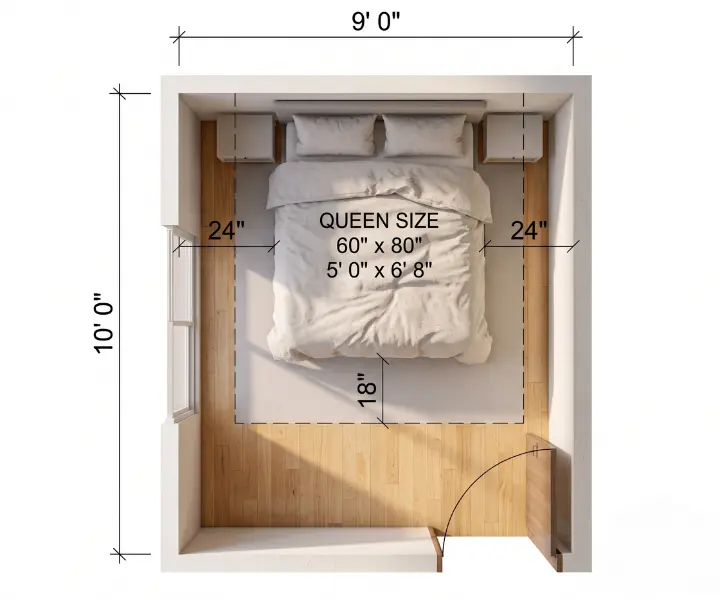
With the headboard on the short wall and space on both sides, you get the most usable access and a balanced look. It needs a room of roughly 9 by 10 feet or more for a double bed, with about 24 inches on each side and 18 inches at the foot.
Bed with the foot towards the window
If the window is on the opposite wall, the bed can face it. It can make a room feel bigger and gives you daylight in the morning, but make sure the bed isn’t blocking the window or the route to it.
Which layout fits which room size
| Room (ft) | Bed | What works |
|---|---|---|
| 8 x 8 | Double | Any wall. Both sides open, 21 inches at the foot. |
| 8 x 8 | Queen | Any wall, but one long side must sit against a wall. Foot gap is exactly 18 inches. |
| 8 x 10 | Queen | The 10 ft wall gives both sides open but only 18 inches at the foot. The 8 ft wall needs one side tucked, with 42 inches at the foot. |
| 9 x 10 | Queen | Either wall, both sides open. 42 inches at the foot on the 9 ft wall, 30 inches on the 10 ft wall. |
| 10 x 10 | King | Any wall, both sides open at exactly 24 inches each. |
| 9 x 10 | King | The 10 ft wall gives both sides open. The 9 ft wall works only with one side tucked. |
For more on dimensions and space planning, take a look at our guides on storage beds and the latest wood bed design trends.
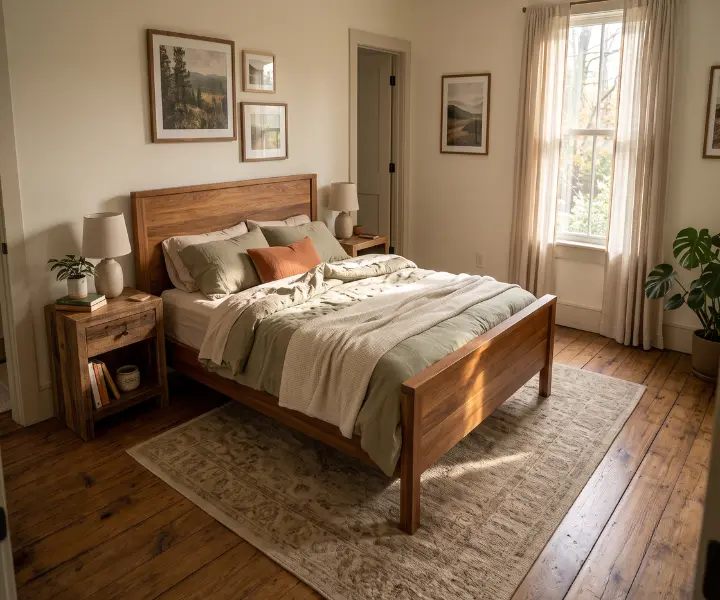
How to find your bed direction
You can work it out in a few minutes.
- Use a compass. A phone compass app works, though it can be thrown off by metal furniture, steel beams or electronics, so check it in a few spots and away from your phone case if it has a magnet.
- Stand where the head of the bed will be, and note the direction you’d be facing.
- Check it against your floor plan. If your home’s plan has a north arrow, use that to confirm.
- Check with a second reading. Take the reading at two points in the room to make sure it’s consistent.
- Accept a small tolerance. Few rooms line up perfectly with the compass, so a close match is usually enough.
Remember that “south-facing” in Vastu means the head points south, which isn’t the same as the direction the room’s door or windows face.
What if you can’t follow the ideal direction?
In a small room you often can’t. If the layout only works with the head to the north, here are some options:
- Choose another wall, if one is available, even if it takes a bit more rearranging.
- Shift the bed slightly, since some practitioners treat small angle changes as enough.
- Focus on other rules: a solid headboard, a clear space under the bed, no mirror opposite, and a calm, uncluttered room.
- Don’t force it. A cramped, awkward layout that blocks the door or window is worse for daily life than a slightly off direction.
If you follow Vastu closely, a Vastu consultant can advise on your specific room. If you’re more relaxed about it, comfort and function should lead.
Choosing the right bed for a small room
Direction aside, the type of bed you pick makes a big difference in a compact room.
Go for storage
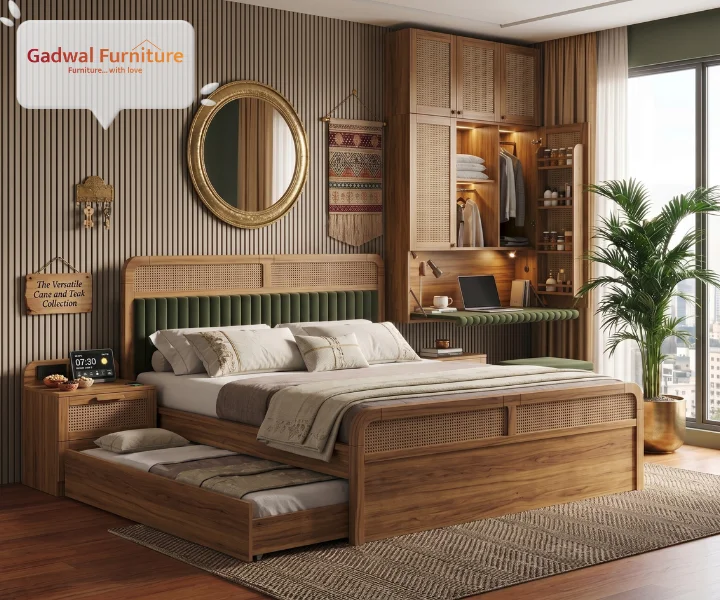
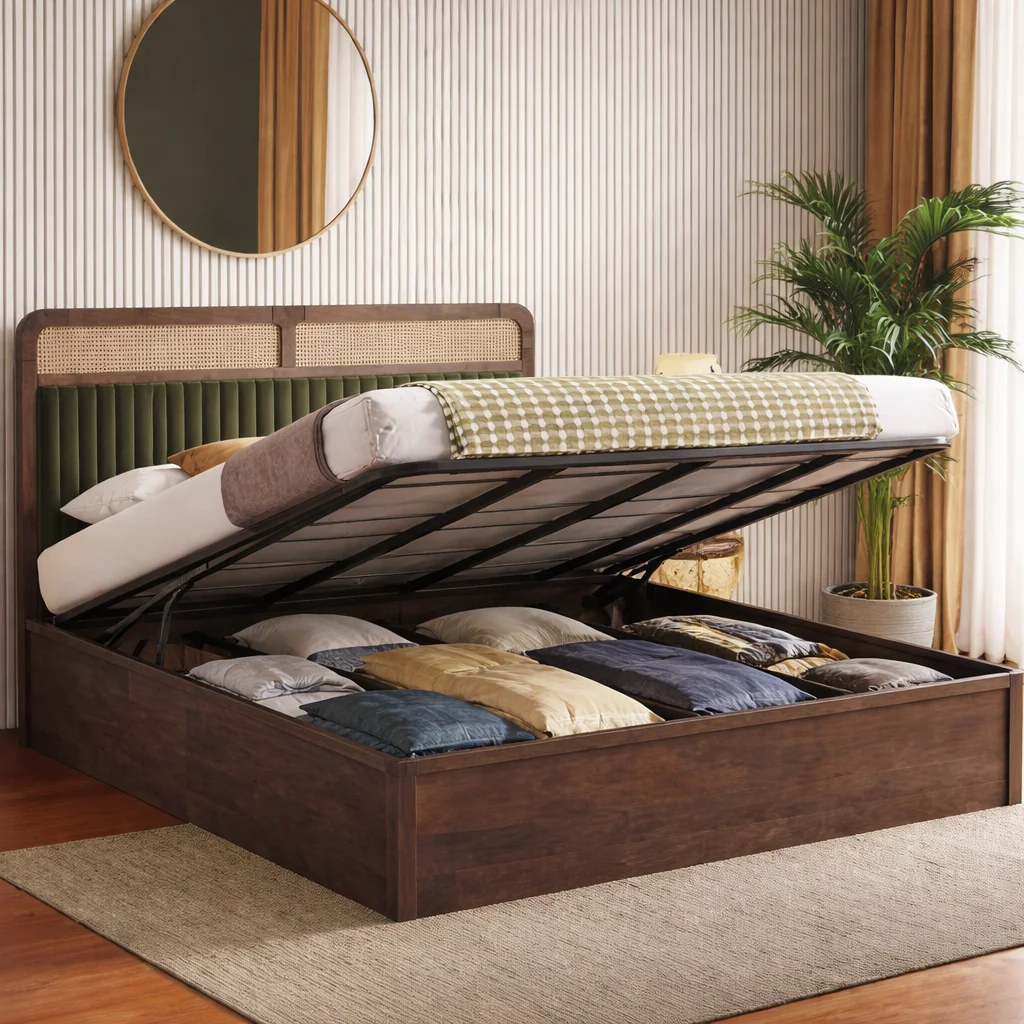
A bed with storage uses the space under the mattress, so you can skip a bulky wardrobe or chest. In a small room, that’s often the best way to free up floor space. Drawer beds are good for everyday items, while box and hydraulic beds hold larger things. Our hydraulic bed buying guide explains how lift-up storage works. The Norma Sheesham Wood Bed with Storage (₹41,999) is one example from our range.
Think low and simple
A low-profile bed with a slim headboard makes a small room feel more open, and a simple frame is easier to place. The Amaris Low Floor Solid Wood Double Bed (₹28,999) is an example of a low design.
Pick the right size
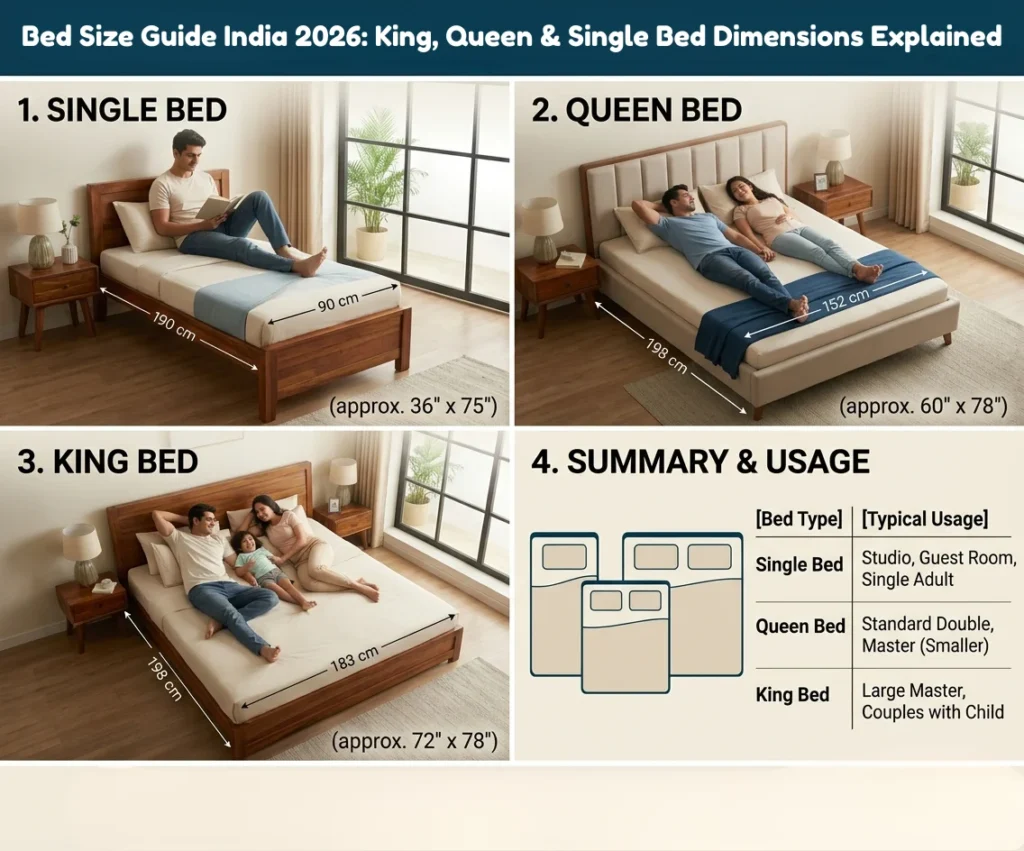
A double bed fits a room of roughly 9 by 10 feet. In anything smaller, a single or a compact double is often the better choice. Don’t buy the biggest bed that technically fits, because you also need space to open drawers, doors and wardrobes.
Choose solid wood
Solid wood holds up well to daily use and handles humidity better than engineered boards, which matters in a closed small room. Our honest guide to solid sheesham wood furniture explains how it behaves over time. To see more options, browse the queen and king size beds collection or the wider bedroom collection.
Prices change with promotions, so check the product pages for current figures.
Small-room bed placement mistakes to avoid
- Blocking the door. If the door can’t open fully, the layout isn’t working.
- Pushing the bed against every wall. It looks tidy but makes the room harder to use.
- Ignoring the fan and AC. Direct airflow can make sleep uncomfortable.
- Putting a mirror opposite the bed. It can feel unsettling at night.
- Cluttering the area under the bed. Use proper storage and keep it organised.
- Over-focusing on direction. A perfect direction doesn’t make up for a cramped, noisy or stuffy room.
A quick checklist
Before you settle on a position, run through this:
- Is the headboard against a solid wall?
- Is the bed out of direct line with the door?
- Can you open the door, wardrobe and drawers fully?
- Is there about 24 inches of space on at least one side, and 18 inches at the foot?
- Is the head towards the south or east, if that’s possible?
- Is the fan or AC airflow comfortable?
- Are there any mirrors or beams that bother you?
- Is the room still easy to move through?
FAQs
Which direction should the bed face in a small room?
Traditional Vastu advice is to sleep with your head towards the south or east. In a small room, also make sure the headboard is against a solid wall and the bed isn’t directly in line with the door.
Is it bad to sleep with your head towards the north?
Vastu and some other traditions advise against it, though there’s no solid scientific evidence of harm. If the layout forces it, shift the bed if you can, and focus on a comfortable, uncluttered room.
Can the bed be under a window?
Yes, if there’s no other option. Use thick curtains, and pick a low headboard so it doesn’t block the window.
Should my feet point towards the door?
Many traditions advise against it, mainly because it feels exposed. If it’s the only layout, move the bed slightly to one side or add a bench or curtain at the foot.
What’s the best bed for a small room?
A bed with storage underneath and a simple, low-profile frame usually works best, since it frees up floor space.
How much space do I need around a double bed?
Aim for about 24 inches on at least one side and 18 inches at the foot. A room of roughly 9 by 10 feet fits a double bed with a bedside table and a compact wardrobe.
Does the bed direction really affect sleep?
There’s no strong evidence that direction alone changes sleep quality. Comfort, noise, light, airflow and a calm room matter more, though many people choose a direction for cultural or personal reasons.
Which direction is best for a child’s bed?
Traditional advice often suggests east or west for children and students. Keep the bed away from the door and the window glare, and use a simple, sturdy frame.
For more info, contact: support@gadwalfurniture.com
Follow our Instagram : Gadwal Furniture