Blog
Bookshelf Placement Guide: Wall Side or Room Divider, What Works Better at Home?

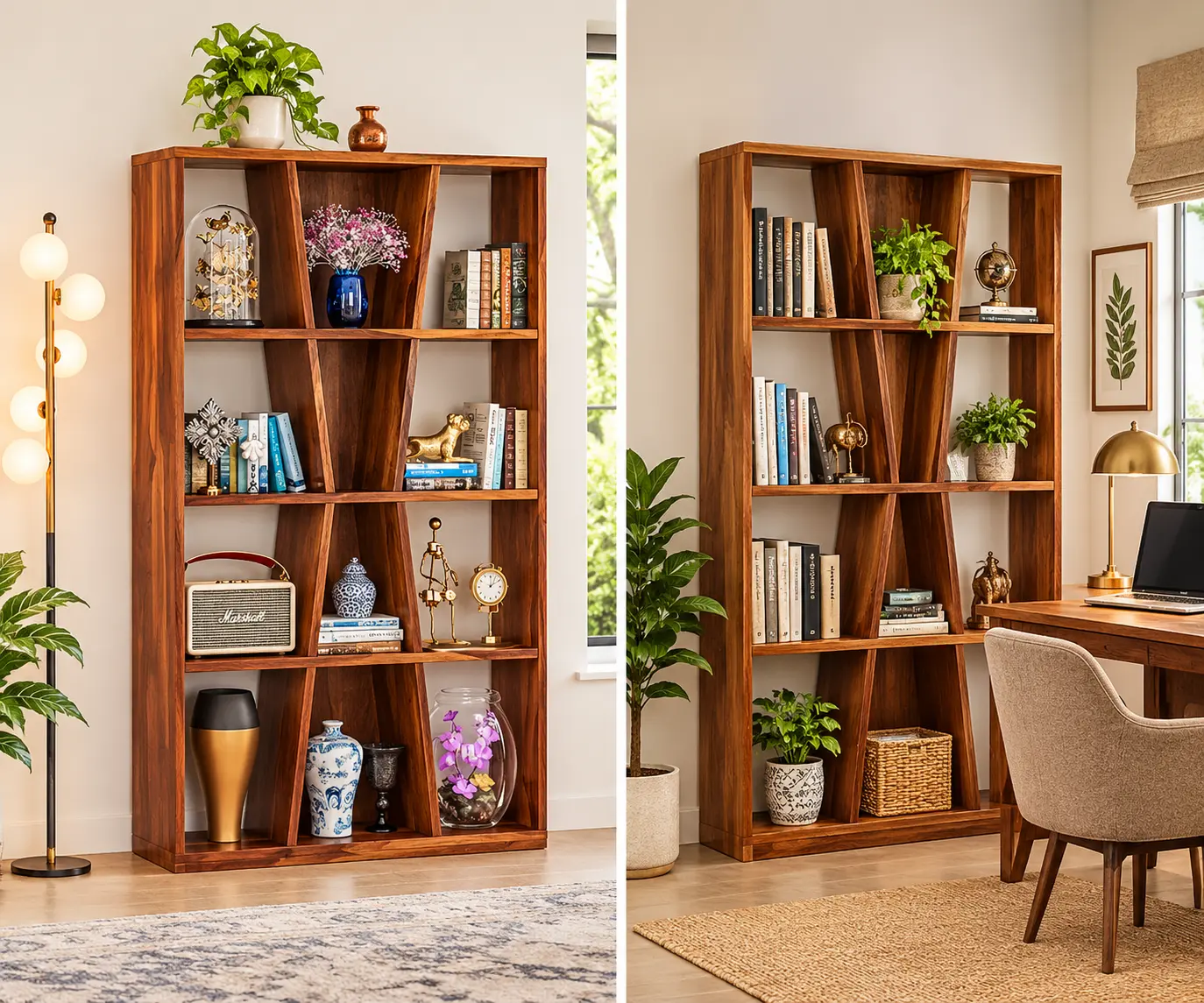
You have found the perfect bookshelf. Now comes the question nobody warns you about: where does it actually go?
Most of us push it against a wall without thinking twice. But in many homes, especially open plan halls and studio flats, a bookshelf can do something cleverer. It can draw a line through the room and turn one big space into two comfortable ones.
Both ideas are good. The trick is knowing which one suits your room, and how to avoid the usual mistakes.
Here is the quick answer. A wall is the better default. It is more stable, it uses less floor and it works in almost every room. Turn a bookshelf into a divider only when both zones still have space for their own furniture plus a walkway of 76 to 91 cm (30 to 36 inches), and only when the unit is fixed at one end or kept low, under about 110 cm (43 inches). Any bookshelf taller than roughly three times its depth should be fixed to a wall. Vastu traditions disagree about direction, so think of it as a preference and not a rule.
Let us walk through it step by step, in plain language.
Why Placement Matters More Than You Think
A bookshelf is one of the rare pieces of furniture with two lives. Against a wall, it keeps your books and slowly becomes part of the background. Out on the floor, it can separate a living area from a dining area, a bed from a study desk, or a corridor from the entrance.
But both lives come with risks. The usual problems are tipping and tight walking space. Which placement is right depends more on your floor plan than on your taste. So in this guide we will cover the measurements, the safety rules for freestanding shelves, and how the answer changes from an open hall to a small flat to a bigger house.
A Simple Test to Pick the Right Option
Pick the wall if you only need storage. Pick a divider if a single room has to serve two purposes and you can spare the floor.
Here is a quick way to check:
- List the furniture both zones will need and add up the space.
- Add 91 cm for each walkway.
- Add the 35 to 40 cm that the divider itself takes up.
If the total is larger than your room, the divider will not work, and the wall is your answer.
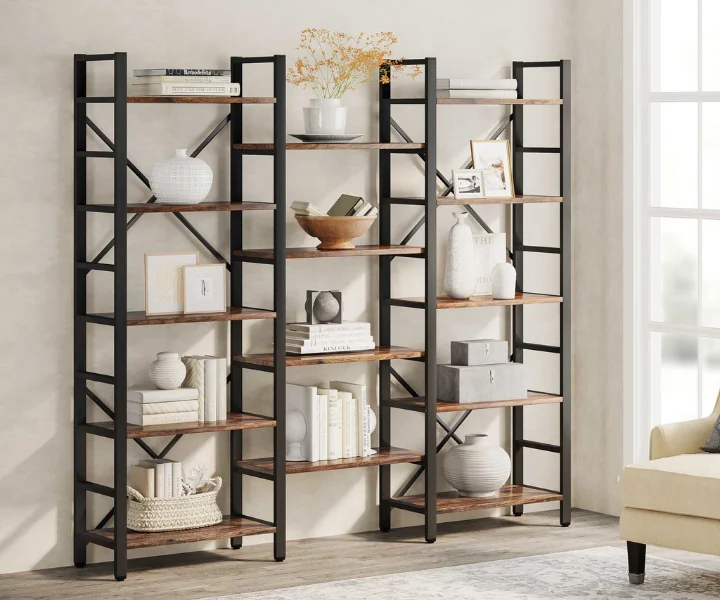
Bookshelf Bookcase Storage Rack
When the Bookshelf Goes Against the Wall
The wall is where a bookshelf is happiest. You can screw it into the brickwork, it takes up only its own depth, and a corner that was hard to furnish suddenly gets a job. It is also the easiest layout to live with, because nobody has to walk around it.
There is a price to pay, though. You give up one full wall. Windows, switchboards, AC units and doors all decide where a tall wooden shelf can stand, and a long stretch of shelving can make a small room feel heavy. And a wall placement does nothing to separate spaces, so an open plan home will remain open.
Numbers to plan with:
- Shelf depth is usually 30 to 40 cm (12 to 16 inches).
- Keep a clear 76 to 91 cm (30 to 36 inches) in front, so you can reach every shelf and still walk behind a chair.
When the Bookshelf Becomes a Room Divider
Yes, a bookcase can be a room divider, as long as it follows three simple conditions. It should be anchored at one end or kept low. It should leave a walkway of 76 to 91 cm on each side. And it should look finished from both sides, with either open shelves or a properly polished back panel.
Tall units divide a room firmly. Low units divide it visually while letting light move freely.
Height is the main decision, so here is how each range behaves:
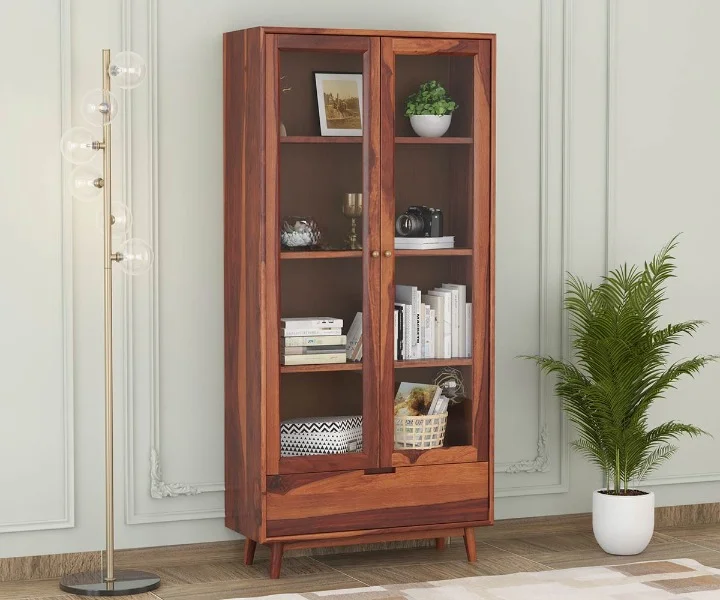
| Divider height | What you get | Best used for |
|---|---|---|
| 70 to 110 cm (28 to 43 inches) | A marked zone with the view and light intact | Living from dining, entrance from hall |
| 120 to 150 cm (47 to 59 inches) | Blocks the view when you sit, still lets air pass | Home office corner, sleeping zone in a studio |
| 165 to 180 cm (65 to 71 inches) | Firm division, less light and sound | Larger halls that need clear separation |
One honest note: a bookshelf will not soundproof a room, and it will not give a bedroom the privacy of a real wall. What it does well is organise the space and add storage along the way.
Two checks before you commit
First, the back. A plain panel back is fine against a wall, but it looks unfinished from the other side. For a divider, choose open shelves or a back that is polished just like the front.
Second, the airflow. A tall, closed unit in front of an AC outlet or under a ceiling fan can change how the room cools. It is far cheaper to find this out with masking tape on the floor than after delivery. Our guide to visualising furniture before you buy it explains the tape method.
Side-by-Side: Wall vs Divider
| Against a wall | As a room divider | |
|---|---|---|
| Stability | Can be fixed to the wall | Needs a fixed end, or a low height |
| Floor space | Only the depth of the unit | Depth plus walkways on both sides |
| Light and air | Mostly unchanged | Tall units reduce both |
| Look | One side is visible | Both sides are visible, so both must look good |
| Privacy | None added | Some, depending on height and back |
| Best for | Almost any room | Open plan halls and studios |
Does a Bookshelf Need to Touch the Wall?
It does not need to touch a wall to work, but a tall one should be fixed to one. Low or wide units are perfectly happy standing in the middle of a room. The tall, narrow ones are the ones that tip, and they are safest when anchored to masonry at the top.
That leaves a practical puzzle for dividers, since they cannot lean on a wall along their length. The answer is to let one short end meet a wall or a pillar, so you can fix the unit there. It then forms a T or an L with the wall and stays steady, while the other end remains open for people to walk through.
How Much Space Does Each Option Need?
| Item | Recommended measure |
|---|---|
| Shelf depth | 30 to 40 cm (12 to 16 inches) |
| Walkway in front of a wall unit | 76 to 91 cm (30 to 36 inches) |
| Walkway on each side of a divider | 76 to 91 cm (30 to 36 inches) |
| Opening at the end of a divider | At least 80 cm (31 inches), more if two people pass |
| Gap between shelves | 30 to 35 cm (12 to 14 inches), or 40 cm for large art books |
Let us try a real example
Say your living and dining hall is 12 feet wide and 20 feet long, which comes to 366 by 610 cm. You line up three of our Multi unit Bookcases, each 90 cm wide. Together they cover 270 cm of the width and leave a 96 cm gap, enough for comfortable movement.
The divider itself takes only 35 cm of the 610 cm length, so the two zones share about 575 cm. If your dining table and chairs need 300 cm on their own, you can see right away whether the sitting side still works. A few minutes with a calculator saves a lot of trouble later.
Safety for Freestanding Bookshelves
Bookshelves fall over when a tall, narrow unit is loaded near the top, or when a child climbs it. Solid Sheesham is dense and heavy, which helps a lot, but weight at the bottom does not replace a fixing at the top.
The easiest check is the height to depth ratio. As a rough guide, and please note this is our own rule of thumb and not an official standard, anchor any unit taller than about three times its depth.
Here is how three of our bookcases compare, using the sizes on their product pages:
| Bookcase | Size (L x W x H) | Height to depth | Anchor it? |
|---|---|---|---|
| Solid Wood Cane Book Shelf | 34 L x 18 W x 60 H Inch | 2.0 | Not essential, but wise with children around |
| Solid Wood Cane Book Shelf | 17 L x 17 W x 72 H Inch | 5.0 | Yes |
| Solid Wood Book Shelf | 34 L x 14 W x 72 H Inch | 5.1 | Yes |
Six simple steps for a safe shelf
- Fix the top to the wall. Use an L bracket or an anti-tip strap with a wall plug in brick or concrete. Plaster alone will not hold.
- Put heavy books low. Keep the top shelf for light items.
- Check the floor. Our product pages mention that up to 5 mm of unevenness is normal, so place small furniture pads under any leg that rocks.
- Secure dividers at one end. Fix one end to a wall or join two units back to back. If neither is possible, keep the height under about 110 cm.
- Respect the span. Long shelves with dense books will bow over time. A common guide is to keep unsupported spans under about 80 to 90 cm for heavy loads.
- Never skip anchoring around kids and pets. With small children or pets at home, anchoring is compulsory, not optional.
Which Placement Suits Your Room?
Open plan living and dining
This is where a divider earns its place. A unit about 120 to 150 cm high, or a row of low units, separates the sofa from the dining table without closing the room. Let one end meet a wall and leave the other end open. Also make sure it does not cut across the line between the AC and your seating.
Small apartments and small rooms
In a small room, the wall almost always wins. Choose a slim unit, about 30 to 35 cm deep, and use the height of the wall, since floor space is what you lack. A corner bookcase or a wall mounted design saves even more space.
A divider in a small room usually costs more in light than it gives back, with one nice exception. In a studio, a low unit at the foot of the bed can mark the sleeping zone without blocking the window. If a bed is part of your plan, our bed size guide will help with clearances.
Larger rooms and living room walls
A large living room can take a tall unit on a feature wall, a pair on either side of a window, or a divider between the seating area and a study corner. You get more freedom, but also a higher chance of the shelf looking lost, so scale matters. Our post on the 2/3 rule for sofas explains a proportion check that works just as well for the wall behind a bookcase.
What Is the Bookshelf Rule?
There is no single official bookshelf rule. The phrase gets used for three different ideas:
- A styling rule of thirds: about a third books, a third objects and a third left empty.
- A stability rule: heavy items low, light items high.
- A sizing rule: borrowed from the two thirds proportion used for sofas.
The stability rule matters most, because it is the only one with a safety consequence. The styling rule is a starting point and nothing more. If you have read three different rules of thirds in a row, it is because designers like the shape of the idea, not because anyone measured it.
Where Should a Bookshelf Go According to Vastu Shastra?
It is worth saying plainly: Vastu sources disagree on this. Several recommend the west or south wall for bookshelves, and some name the south west. Others prefer the east or north, and a few specifically advise against the south west or north west. Some suggest the north east corner, while others say the north east should stay light and open.
The points where sources tend to agree are smaller:
- Avoid placing shelves directly above a bed.
- Avoid heavy loading in the north east.
- Many practitioners prefer the centre of a home to stay open, which is one more reason to place a divider off centre and keep it low.
If Vastu matters in your family, choose the wall that matches the tradition you follow, or ask a practitioner you trust. Use the practical advice in this article for measurements. And please do not buy or move a bookshelf for Vastu alone if the room cannot take it safely.
Styling a Shelf That Is Seen From Both Sides
A divider has two faces, so style it like furniture and not like storage. Keep the books on the dining side as tidy as the living side, because both will be noticed.
- Mix book spines with a few objects, such as a plant, a lamp or a brass piece.
- Leave some shelves partly empty so light and sightlines pass through.
- Group books by height or colour in one section, and lay a few flat to break up the vertical lines.
- On a wall unit, use a lower shelf for baskets that hide the things that look messy.
If you keep the unit open, accept a little extra dusting. Closed or glass fronted sections protect special books and keep the look cleaner, and a mix of both is often the most practical.
Common Bookshelf Placement Mistakes
The most frequent mistake is placing a tall, narrow unit in the middle of a room with nothing fixing it. The second is forgetting the walkway, so a divider leaves only 50 cm to squeeze through. The third is covering a switchboard, a window or an AC outlet, and the fourth is buying a unit with an unfinished back for use as a divider.
A few more to watch for:
- Loading all the heavy books high up
- Putting a wall unit where a door or window must swing
- Choosing a size by looks alone
Measure the wall first, and measure the route into the room as well. Solid wood is heavy, and getting a large unit through a lift or a narrow turn is not something to improvise on delivery day.
Why Solid Sheesham Suits This Job
A bookshelf carries a heavy, concentrated load for years, and a divider has the added burden of standing without a wall behind it. That is where the material counts. Solid Sheesham is dense and strong, so shelves resist sagging and joints stay tight under weight.
Our bookshelves are made from 100% solid Sheesham wood, with no MDF or particle board. They come with a lifetime warranty for termite resistance, plus a 12 month warranty against manufacturing defects.
Solid wood also behaves like wood. It can develop small surface cracks over time, called checks, which are natural and do not affect strength. Colour and grain vary from piece to piece, so a finish will not match a photograph exactly. For many people, that variation is the charm.
Three bookcases that fit these placements
If you are ready to compare designs, explore the full range in our bookshelf collection. Here are three that suit the placements in this article, with sizes taken from each product page:
| Bookcase | Size | Suits |
|---|---|---|
| Solid Wood Cane Book Shelf | 34 L x 18 W x 60 H Inch | A low divider behind a sofa or at the foot of a bed, or a wall unit under a window. Comes in honey, walnut and stone, ready to use with no assembly. |
| Solid Wood Cane Book Shelf | 17 L x 17 W x 72 H Inch | A tall wall unit for a living room, or a firm divider when several are placed side by side and one end is fixed to a wall. Honey, stone and walnut, ready to use. |
| Solid Wood Book Shelf | 34 L x 14 W x 72 H Inch | A compact cube layout for a smaller room, where a slightly shallower depth helps. Honey, stone and walnut. |
For tight spots, our collection also includes a wall mounted bookcase and a corner bookcase, which keep floor space free in a small room. Check the size on each product page against your own tape outline before you order. If a standard size is slightly off, we make custom sizes and finishes.
Frequently Asked Questions
How tall should a bookshelf room divider be? A height of 120 to 150 cm (47 to 59 inches) divides a room while letting light and air pass. Go lower, 70 to 110 cm, to keep a view across the room, or higher, 165 to 180 cm, when you want firm separation and can anchor one end to a wall.
Will a bookshelf divider block light and AC airflow? A tall, closed unit will reduce both. Open shelves, a lower height, or leaving a gap above the unit lets light and air through. Keep the divider away from the line between an AC outlet and the seating or bed it serves.
Does a bookshelf divider need a back panel? Not necessarily. Open shelves are usually the best choice, since you can see through them. If the unit has a back, it should be finished on both sides, as an unfinished panel looks poor from the other room.
How do I stop a freestanding bookshelf from tipping? Fix the top to a wall with an L bracket or an anti-tip strap, load heavy books on the lowest shelves, and keep the floor level. For a divider, anchor one end to a wall or keep the unit under about 110 cm high.
How far should a bookshelf sit from the wall? As close as the skirting board allows, usually 1 to 2 cm. A small gap keeps books from falling behind and makes it easier to fix the unit to the wall.
Is a solid wood bookshelf safer as a room divider than an engineered one? A heavy solid wood unit is harder to push over, and it holds shelves and joints better under load. It still needs anchoring if it is tall and narrow, because weight alone does not stop a loaded shelf from tipping.
Final Thoughts
Start with tape on the floor. Mark the depth of the unit, the walkways on each side and the swing of any door. If the plan still works, a divider can organise a room beautifully. If it does not, a bookshelf on the right wall will give you most of the storage with none of the compromises.
Whichever you choose, go for solid wood, fix tall units to the wall and leave enough room to walk. Browse the full solid Sheesham bookshelf range at gadwalfurniture.com, or send us your room size and we will help you choose the right height and finish.
For more info, contact: support@gadwalfurniture.com
Follow our Instagram : Gadwal Furniture