Blog
How to Visualise Furniture in Your Home Before Buying: Easy Tips & Tools

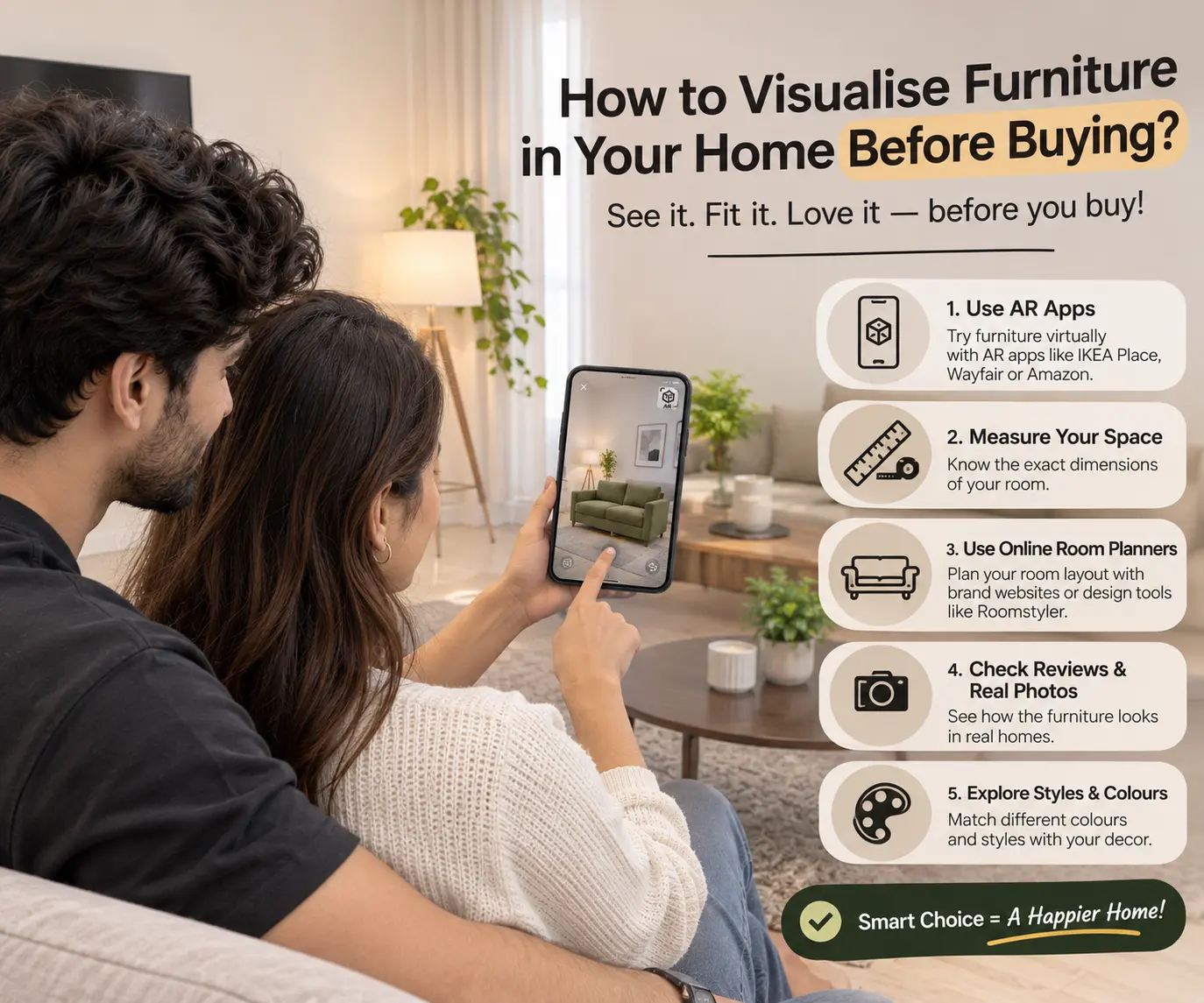
The most reliable way to visualise furniture before you buy it is to mark its exact footprint on your floor with masking tape, then check its height, the walking space around it and the route it has to travel to get inside. Apps and AI images help you compare styles and colours. Tape and a measuring tape tell you whether the piece will actually fit.
A sofa that looks modest in a product photo can swallow a living room. A bed that seemed fine in the showroom can leave a wardrobe with no room to open. This happens to careful buyers all the time, and it is rarely a question of taste. It is a question of scale, and scale is very hard to judge from a screen.
Product photos are shot in large, bright rooms with wide lenses. Showrooms have high ceilings and generous floors. Your room has a ceiling fan, an AC unit, a switchboard, a curtain rod and a door that opens inward. This guide shows you how to bring the furniture into that room before you pay for it, starting with the cheapest and most reliable methods and moving on to the tools that help with style.
Start with the footprint, not the photo
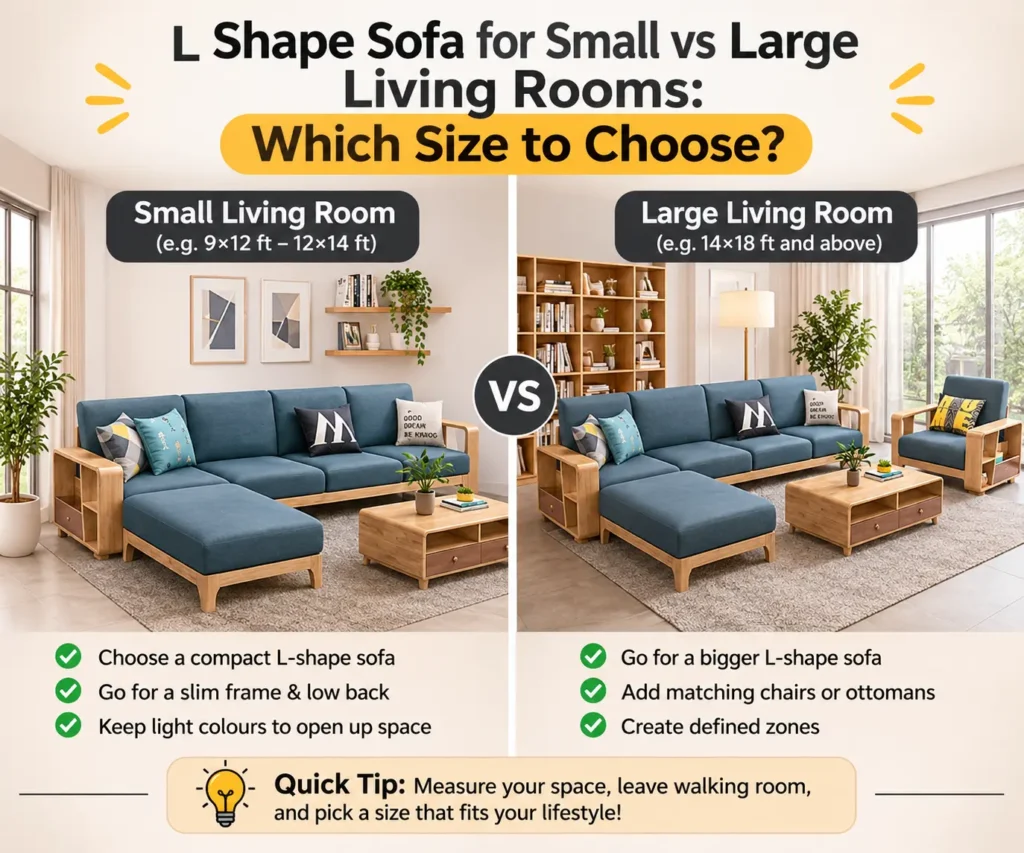
Find the width and depth in the product listing and mark that rectangle on the floor with masking tape. Put it exactly where you imagine the piece standing. For a bed, include the headboard depth. For an L shape sofa, tape both arms of the L, because the shorter arm is usually the one that ends up in the way.
Then live with the outline for a day or two. Walk around it carrying a cup of tea. Sit on the floor inside it. Cross the room at night half asleep to get a glass of water. Most fit problems show up in the first two days, not in the first five minutes. If you would rather not put tape on a polished floor, flattened cartons or newspaper sheets taped together do the same job.
This one step also settles the argument many couples have over a sofa or bed, because the outline is on the floor and both people can walk through it.
Build the height with cardboard
A footprint says nothing about how tall a piece feels. Cut a strip of cardboard or stack a few boxes to the listed height and stand it at the back edge of your outline. Then look at what it covers.
Does the back of the sofa cross a window sill, a switchboard or the path of a wall mounted AC? Does a headboard in your bed design reach a window or sit under a pipe? Is there enough gap between a tall wardrobe and the ceiling or fan? For a TV unit, sit down and check where the screen lands against your eyes.
While you are at it, mark the swing of every door and drawer as an arc of tape. A wardrobe door that hits the bed is a very common regret and a very easy one to catch.
Measure the route, not only the room
Some pieces fit the room perfectly and still cannot get in. Measure the narrowest point between the building entrance and the final spot: the lift interior and its door, staircase turns and landings, the main door, any corridor and the room door. Compare these with the longest and widest packed dimensions of the piece.
Solid wood furniture is heavier and less forgiving than hollow flat pack furniture, so turning a large assembled piece on a tight staircase is not something to improvise on delivery day. Ask whether the piece ships assembled or in parts, and which part is the largest.
If a standard size is only a few inches too big for a wall, a niche or a stairwell, a custom size is often the cleaner fix than compromising on the whole layout. Gadwal makes furniture in custom sizes and finishes, and your tape outline is exactly the measurement you would give us.
See the colour in your own light
Screens are not honest about wood. Display brightness changes the tone, and the warm bulbs in your room at night make honey colours look deeper than they do in a daylight product shot. Sheesham is a natural material with grain that varies from piece to piece, which is a big part of its charm and also the reason no single photo can promise exactly what your piece will look like.
Look at the listing once in daylight and once in the evening with your own lights on. Hold your phone near your floor tiles and wall colour and see whether the finish feels like it belongs. If there is a Gadwal showroom near you, seeing the finish in person settles it faster than any amount of zooming.
Where apps and AI help, and where they mislead
Once the tape tests are done, digital tools answer questions tape cannot, such as how a rust red rug sits next to a dark wood sofa, or whether the sofa works better floating than against the wall.
| Method | What it does well | Where it can mislead |
|---|---|---|
| Tape and cardboard | Real size and real walking space, and it costs almost nothing | Shows nothing about colour or style |
| Phone AR | A quick look at a piece through your camera | Scale can drift and the lighting rarely matches your room |
| 3D room planner apps | A full layout with measured walls, easy to compare arrangements | Only as accurate as the measurements you type in |
| AI generated room images | Mood, colour and styling ideas | Can quietly change the room size, windows and furniture proportions |
If you use an AI image tool, give it a straight, wide photo of the room, tell it to keep the walls, windows and flooring unchanged, and type in the real dimensions of the piece. Then compare the result with your tape outline. If the sofa in the image looks smaller than the tape rectangle on your floor, trust the tape.
How much space to leave around each piece
These are common design rules of thumb. Adjust them upward if you have young children, elderly family members or anyone who uses a wheelchair or walker.
| Piece | Space to aim for | What it protects |
|---|---|---|
| Main walkways | 30 to 36 inches | Walking through without turning sideways |
| Sofa to coffee table | 14 to 18 inches | Reaching a cup while keeping legs comfortable |
| Beds, on each side you use | At least 24 inches | Getting in and out, making the bed |
| Dining chairs | About 36 inches from table edge to wall | Pulling a chair back and sitting down |
| Wardrobe and cupboard doors | Full door swing plus room to stand | Doors that do not hit the bed or a person |
If you are choosing a bed, our Latest Wood Bed Design Trends in India shows how each size sits in common Indian bedrooms. For dining, check the dining sets dimensions against your tape outline including the chairs pulled out, and for the living room remember to add a coffee table to the outline, not just the sofa.
A worked example
These numbers are made up to show the method and do not describe a specific Gadwal product. Say your hall is 12 feet wide and 14 feet deep, which is 144 by 168 inches. You like a 3 seater sofa listed at 84 inches wide and 36 inches deep.
You tape an 84 by 36 inch rectangle against the long wall. That leaves 60 inches beside it, enough for a side table and a walkway. A coffee table 24 inches deep with an 18 inch gap in front of the sofa brings the seating zone to 78 inches of the 168 inch depth, leaving plenty for a TV unit and movement.
Then the tape shows something the numbers did not. The right arm of the sofa sits 8 inches from the balcony door, which is too tight to open comfortably. You now have three honest options: shift the sofa, pick a slightly narrower one, or ask for a custom width. Finding that out with tape costs nothing. Finding it out after delivery costs a lot.
The short version
- Mark the footprint on the floor with tape, using the listed width and depth.
- Stand a cardboard strip at the listed height and check windows, switchboards, AC and fan.
- Tape door and drawer swings as arcs.
- Measure the delivery route, including the lift, stairs and doors.
- Check the finish in daylight and in your evening lights.
- Use apps or AI to compare style and layout, and check them against your tape.
Common questions
How can I see furniture in my room before buying it?
Mark the footprint on your floor with masking tape using the listed width and depth, and stand a cardboard strip at the listed height. Then use a phone AR feature or a 3D room planner app to compare styles. Tape tells you about fit, and apps tell you about looks.
Is there an app that shows furniture in my room?
Yes. Phone AR features and 3D room planner apps let you place a model of a furniture piece in your room or a floor plan. They are good for layout and style, but their accuracy depends on the measurements you enter, so confirm the fit with tape before ordering.
How do I know if furniture will fit my room?
Compare the listed width, depth and height with your room measurements, then tape the footprint on the floor. Leave about 30 to 36 inches for walkways and check door swings and the delivery route. If it works with those margins in place, it will fit.
Can AI show exactly how furniture will look in my room?
No. AI images are useful for mood, colour and styling ideas, but they can change room proportions and furniture size without telling you. Treat them as an idea board and check every dimension against your own measurements.
How much space should be between a sofa and a coffee table?
A gap of 14 to 18 inches is common. It keeps the table within easy reach while leaving room for your legs. In a large room you can go slightly wider, but beyond about 20 inches the table starts to feel too far away.
Does wood furniture look the same in real life as online?
Not exactly. Screen settings change colour, and natural wood such as Sheesham has grain that varies between pieces. Look at the finish in daylight and again under your evening lights, and if you can, see it in person before deciding.
Before you order
Every Gadwal listing shows dimensions, and the full range is on our all page. Tape the pieces you like, walk around them for a day or two, and measure the route. If a standard size is a few inches off, tell us what your tape shows and we can talk through a custom size.
For more info, contact: support@gadwalfurniture.com
Follow our Instagram : Gadwal Furniture