Blog
Cafe Interior Design Ideas: 15 Creative Ways to Design a Beautiful Cafe


People don’t remember a cafe because of the coffee machine. They remember the corner table by the window, the warm lighting, the bench they sank into for two hours, and the fact that it felt like somewhere they wanted to be. That feeling comes from design, and good design doesn’t have to mean a huge budget.
This guide gives you 15 practical ideas for designing a cafe that looks good, feels comfortable and works hard for the business. It’s written for cafe owners and anyone planning one in India, with real furniture sizes, spacing rules and rough costs from our solid sheesham range. Skim the quick answer if you’re short on time, then jump to whichever idea you need.
The quick answer
| Priority | What to get right |
|---|---|
| 1. Concept | One clear idea, so every choice supports it |
| 2. Layout | Enough walking space, and a counter that works |
| 3. Seating | A mix of table sizes, benches and counter seats |
| 4. Lighting | Warm, layered and bright where it counts |
| 5. Materials | Warm wood, durable surfaces, easy cleaning |
If you only remember one thing: design for how customers sit, wait and linger, not just for how the room looks in photos.
1. Start with a clear concept
Before you pick a single chair, decide what your cafe is. A quiet bookish corner? A bright brunch spot? A rustic place with filter coffee and live music? A concept doesn’t need to be fancy. It’s just a short description you can use to say yes or no to every decision.
Try writing it in one sentence: “A warm, plant-filled neighbourhood cafe with honey wood and brass details.” Then check each purchase against it. If a neon sign doesn’t fit, leave it out.
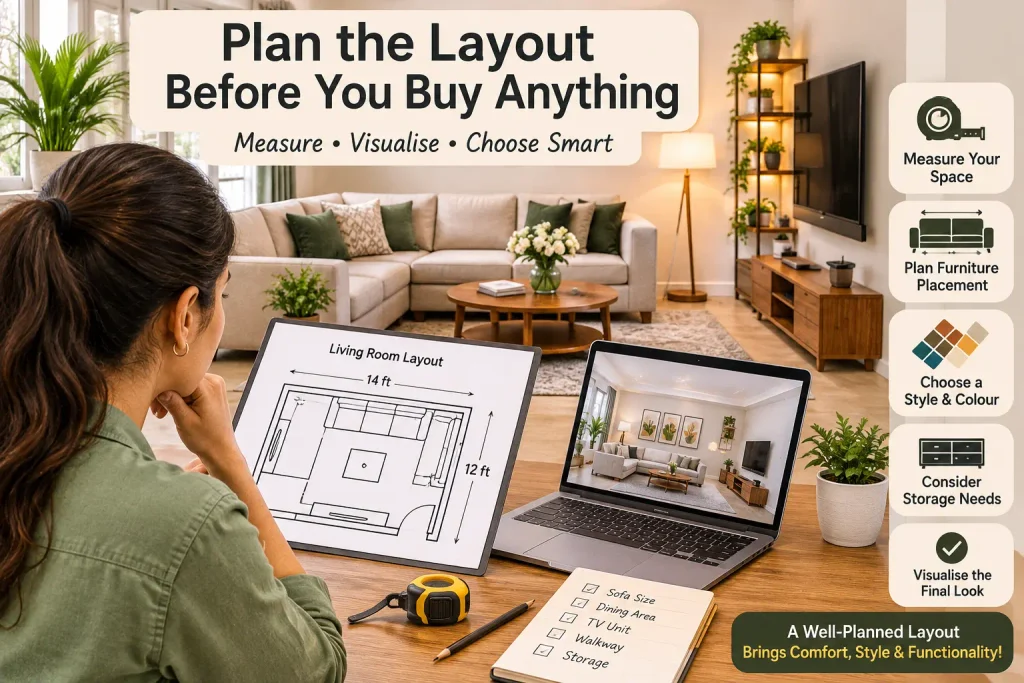
2. Plan the layout before you buy anything
A beautiful cafe that’s awkward to work in loses money. Think about the flow first.
- Entrance: customers should see the counter and a welcoming seating area within seconds.
- Counter and kitchen: keep the route between the machine, the display and the till short.
- Aisles: leave at least 36 inches between tables, and 42 to 48 inches on main routes where staff carry trays.
- Queue space: the area in front of the counter shouldn’t block seated customers.
- Washrooms and exits: keep them clear and signed. Check your local fire and safety rules before finalising the layout.
A simple way to test it: tape the furniture outlines on the floor and walk the route with a tray. You’ll find problems in ten minutes that a drawing would never show.
3. Use a mix of table sizes
A row of identical four-seat tables looks tidy but wastes space. Real cafes have couples, solo laptop workers, groups and families.
- Two-seat tables for couples and solo visitors. Our 2 Seater Solid Wood Dining Set (₹18,599) and the Woodora 2 Seater Dining Set with Cushion (₹19,599) suit small corners.
- Four-seat tables for families and friends. The Hina Rami 4 Seater Dining Set is listed at ₹27,599, and our Wooden Dining Table 4 Seater comes in a round shape that’s friendly in tight spaces.
- Larger tables for groups, if you have the space. See our 6 seater dining sets.
A good starting mix for a small cafe is about half two-seaters, a third four-seaters, and a few flexible pieces that can be pushed together.
4. Add benches and banquette seating
Benches are one of the smartest cafe furniture choices. They seat more people in less space, they tuck under tables, and they give the room a cosy, social feel. A bench along a wall also uses the edge of the room, where chairs would only block the way.
Our seating collection includes the Urban Czar 2 Seater Wooden Bench (₹15,899) and the Sheesham Wood Bench with Cushion (₹8,999). Our guide on bar and bench ideas shows how benches pair with tables at home, and the same principles work in a cafe.
Tips: a bench seat height of about 17 to 18 inches suits standard tables of 29 to 30 inches. Add cushions for comfort if people will stay long, and choose washable covers.
5. Make the counter the star
The counter is where customers pay, order and watch the action, so it deserves attention. A warm wood front, a good-looking espresso machine and a neat pastry display do more for atmosphere than most decor.
- Height: a standard service counter sits at about 36 inches, and a raised bar section at 40 to 42 inches.
- Surface: choose something that handles spills and heat, like sealed wood, stone or tile.
- Lighting: hang pendants above the counter, and keep task lighting bright where staff work.
- Display: keep it tidy and well lit. Clutter looks cheap.
6. Add counter or window seating
A bar along the window or counter suits solo customers, laptop workers and quick coffee drinkers. It also makes the cafe look busier from outside, which attracts people.
- Stool seat height: about 28 to 30 inches for a 40 to 42 inch counter.
- Depth: a ledge about 12 to 16 inches deep is enough for a cup and a laptop.
- Space per person: around 24 inches along the counter.
- Power: put sockets or USB points nearby. Laptop users will thank you.
Choose stools with a footrest and a sturdy frame. Wobbly stools are a safety risk.
7. Design the lighting in layers
Lighting changes a cafe more than any other element. The same room can feel harsh or magical depending on the bulbs.
- Ambient light: soft, warm general light, around 2700 to 3000K for a cosy feel.
- Task light: brighter, focused light at the counter and over the menu.
- Accent light: small pendants over tables, wall lights and spotlights on art or plants.
- Natural light: let it in during the day. Put your best tables near the windows.
Use dimmers so the mood can change from morning to evening. Avoid cool white tube lights, which flatten the look of wood and food.
8. Choose warm, honest materials
Wood is a classic cafe material for a reason. It’s warm, familiar and photographs well. Solid sheesham also takes heavy use, and a scratched top can be sanded and refinished. Our honest guide to solid sheesham wood furniture explains how it behaves over time.
Combine it with other textures to avoid a one-note look.
- Wood and brass: warm and a little glamorous.
- Wood and cane or rattan: light, relaxed and slightly boho.
- Wood and black metal: modern and industrial.
- Wood and stone or tile: easy to clean at counters and tabletops.
Keep to two or three materials per room. Too many looks messy.
9. Pick a colour palette and stick to it
A simple palette makes a small cafe feel designed. Choose one main colour, one supporting colour and one accent.
- Warm and earthy: honey wood, cream walls, terracotta and green plants.
- Fresh and bright: white, light wood and soft pastels.
- Moody and rich: walnut, deep green or navy, and brass.
Test paint colours on the wall and look at them at different times of day. Light changes everything.
10. Bring in plants
Plants make a space feel alive and welcoming, and they cost little. A few big plants beat many small ones.
- Put a large plant in a corner to soften it.
- Hang trailing plants near windows.
- Use shelf plants to break up long walls.
- Choose plants that suit your light. Artificial plants work if you can’t care for real ones, but choose good quality and dust them.
Keep plants away from walkways and tables where leaves might touch customers.
11. Create a signature wall
One memorable wall gives customers something to photograph, and it gives your cafe an identity. It might be exposed brick, a mural, a gallery of local art, a menu board in hand lettering, or a wall of shelves with books and objects.
Keep the rest of the room calm so the wall can shine. Light it properly, since a great wall in bad light looks flat.
12. Think about sound
Noise is the invisible part of design. A beautiful cafe that echoes is tiring to sit in.
- Soft surfaces like cushions, rugs, curtains and fabric panels absorb sound.
- Wood and plants help break up echoes a little.
- Music: keep it at a level where people can talk. Choose a playlist that matches your concept.
- Hard floors and bare walls make noise worse, so mix in softer elements.
Test it on a busy day. If you can’t hear the person across the table, it’s too loud.
13. Design for comfort, not just looks
People stay longer and spend more when they’re comfortable.
- Seat height and depth: a table at 29 to 30 inches and a seat at 17 to 19 inches suit most people.
- Cushions: add them for long stays, with covers that wipe clean.
- Back support: at least some chairs should have backs.
- Temperature and airflow: make sure fans or AC reach all seats.
- Space: don’t squeeze tables so close that neighbours hear every word.
A good rule of thumb is to sit in every seat yourself for twenty minutes before you open.
14. Make the most of outdoor and window areas
A balcony, terrace or pavement table can double your seating on good days and draw people in.
- Choose furniture that handles sun and rain, or cover it. Solid wood outdoors needs protection from direct weather, so ask about finishes and keep it under a canopy.
- Add shade, with umbrellas, awnings or plants.
- Use lighting for evenings, such as string lights or lanterns.
- Keep walkways clear, and think about wind.
If your cafe has a window, put a counter or a few two-seat tables there. It makes the room feel bigger and brighter.
15. Build in durability and easy cleaning
A cafe works its furniture hard. Choose pieces that survive daily use and are easy to wipe.
- Solid wood tops handle weight and can be refinished, though they need coasters and wiping, since heat and moisture mark wood.
- Sealed finishes resist spills, but always wipe quickly.
- Washable cushion covers save a lot of grief.
- Strong joints matter more than decoration. Check chairs and stools for wobble.
- Replaceable parts: pick designs where a cushion or a leg can be fixed or swapped.
If you’re buying many pieces, ask the maker about bulk pricing, custom sizes, finishes and delivery times. It’s better to agree these before you order.
A worked example: furnishing a 24-seat cafe
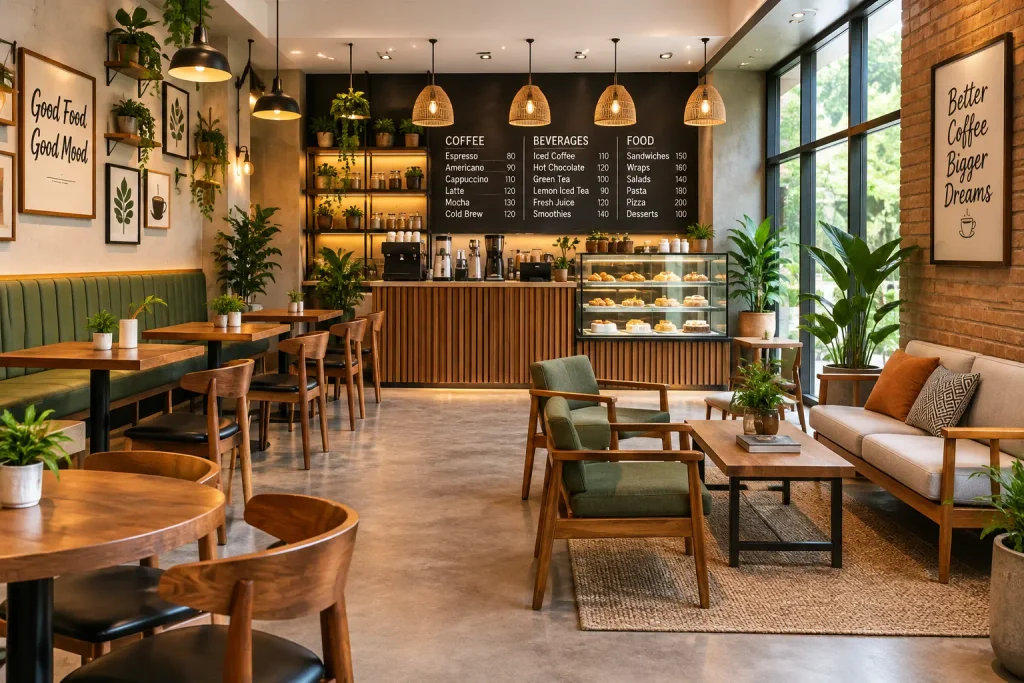
Here’s how a small cafe’s seating might look using current sale prices from our range. These change often, and a bulk quote may differ, so treat this as a planning sketch.
| Item | Quantity | Seats | Approx. cost |
|---|---|---|---|
| Hina Rami 4 Seater Dining Set (₹27,599) | 3 | 12 | ₹82,797 |
| 2 Seater Solid Wood Dining Set (₹18,599) | 4 | 8 | ₹74,396 |
| Urban Czar 2 Seater Wooden Bench (₹15,899) | 2 | 4 | ₹31,798 |
| Total | 24 | about ₹1.9 lakh |
This leaves out the counter, bar stools, lighting, decor and the kitchen. Add those to your budget separately. For a rough idea of the whole project, furniture is often one of the biggest single costs, so it pays to choose pieces that last.
Room-size cheat sheet
A common planning rule is to allow about 12 to 15 square feet per seat in a cafe, including aisles and the counter area. So:
| Cafe floor area | Approx. seats |
|---|---|
| 300 sq ft | 20 to 25 |
| 500 sq ft | 33 to 40 |
| 800 sq ft | 53 to 65 |
Treat this as a starting point, since layouts vary widely and local rules may set limits.
Common mistakes to avoid
- Too many tables. Crowded rooms feel stressful and slow service.
- Ignoring the walkway. Staff and customers both need room.
- Cold, bright lighting. It makes food and people look worse.
- Uncomfortable seats. People leave sooner and don’t return.
- Too many styles. Stick to your concept.
- Skipping acoustics. A loud room is tiring.
- Choosing by photo only. Test the furniture first.
- Forgetting cleaning. Pick surfaces your team can wipe fast.
A planning checklist
- Write your concept in one sentence.
- Measure the room and sketch the layout.
- Decide table and seat mix.
- Add benches and counter seating.
- Plan lighting in layers.
- Choose materials and a palette.
- Add plants, a signature wall and soft surfaces.
- Check comfort, noise and cleaning.
- Confirm furniture details, bulk pricing and delivery.
- Tape out the layout and walk through it.
Frequently Asked Questions
How do I design a small cafe on a budget?
Start with a clear concept, choose a few good pieces of solid wood furniture, use warm lighting and add plants and one feature wall. A tight palette and fewer, better items look better than many cheap ones.
How much space do I need per seat in a cafe?
As a rough guide, 12 to 15 square feet per seat, including aisles and the counter area. Check your local rules too.
What furniture do I need for a cafe?
A mix of two-seat and four-seat tables, chairs or benches, counter or bar stools, and a few flexible pieces. Add storage and display units behind the counter.
What is the best wood for cafe furniture?
Solid wood like sheesham is strong, warm and can be refinished. It needs protection from heat, water and strong sun, so use mats and wipe spills.
How wide should aisles be in a cafe?
At least 36 inches between tables, and 42 to 48 inches on main routes where staff carry trays.
What height should cafe tables and stools be?
Tables are about 29 to 30 inches, and seats about 17 to 19 inches. Counter stools suit a 40 to 42 inch bar at about 28 to 30 inches.
What lighting works best in a cafe?
Warm light of about 2700 to 3000K, layered with ambient, task and accent lighting, and dimmers to change the mood.
Is bulk furniture pricing available?
Ask the maker directly, since prices, finishes and delivery times for larger orders may differ from the listed single-piece prices.
For more info, contact: support@gadwalfurniture.com
Follow our Instagram : Gadwal Furniture