Blog
Modern Wooden TV Unit Designs: Storage, Size and Style Compared

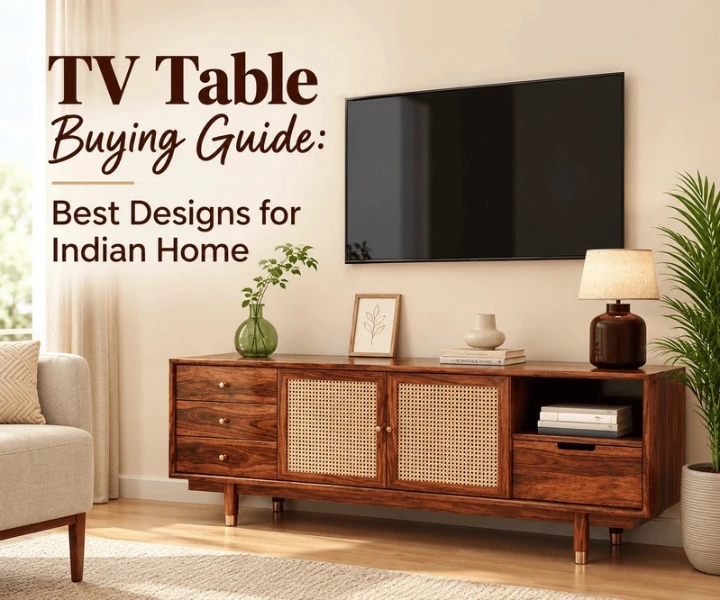
Think about the last time you walked into a friend’s living room. Before the sofa, before the curtains, your eyes probably landed on the TV wall. It is the visual centre of most Indian homes, and the TV unit sitting beneath that screen decides whether the room feels calm and organised or cluttered and chaotic.
That is why choosing the right TV unit is a bigger decision than it first looks. You are not just buying a place to rest your television. You are choosing where your remotes, gaming consoles, set-top boxes, books, photo frames and family board games will live. You are also choosing how the whole room will feel.
In this guide, we compare modern wooden TV unit designs across the three things that matter most: storage, size and style. We keep the language simple, share the mistakes we see people make again and again, and give you a practical checklist you can carry into any furniture showroom. Whether you are furnishing a new flat or refreshing an old living room, by the end you will know exactly what to look for.
Why Wood Still Wins for TV Units
Metal, glass and laminate all have their fans, but wood remains the most loved material for TV units, and for good reasons.
It looks warm. A screen is a cold, dark rectangle. Wood softens it. The grain, the colour and the texture add a natural feel that plastic or metal simply cannot copy.
It is strong. A 65-inch television can weigh 25 to 30 kilograms, and the unit also carries speakers, a soundbar and décor. Solid wood and good-quality engineered wood handle this load without sagging when they are built properly.
It suits every style. A deep walnut finish looks classic. A light oak tone looks Scandinavian. A rich teak colour looks traditional. The same material adapts to your taste.
It lasts. Cared for sensibly, a wooden unit can serve a family for many years, and a solid wood piece can often be refinished instead of replaced.
The key is choosing the right kind of wooden TV unit for your room, which brings us to the first big comparison: storage.
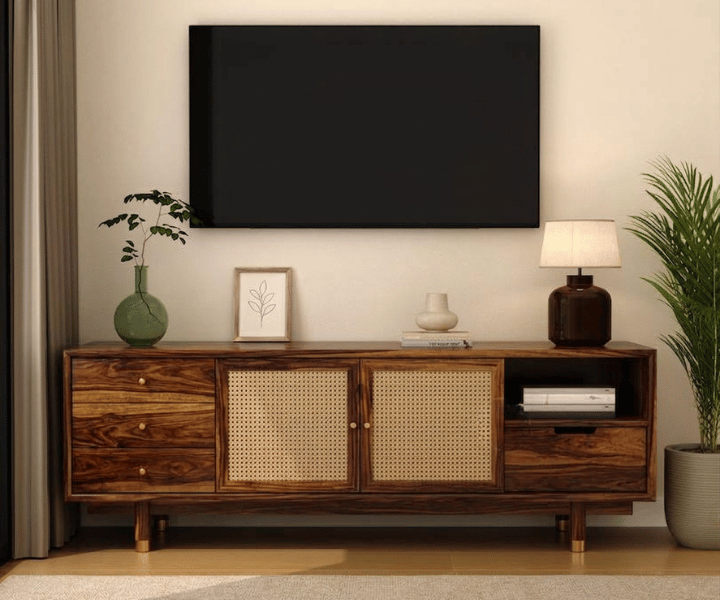
Eka Solid sheesham wood and Cane TV Unit
Storage Compared: Open, Closed or a Mix?
Storage is where most people go wrong. They fall in love with a sleek design in a catalogue, bring it home, and discover there is nowhere to hide the router, the cables or the kids’ toys. Let us break down the main storage styles so you can match one to your lifestyle.
1. Open Shelf TV Units
Open shelving is the most airy and modern option. You can display books, plants, small sculptures or framed photos, and your devices get plenty of ventilation.
Best for: minimalists, small families, people who enjoy styling shelves, and anyone with a gaming console or streaming box that runs warm.
Watch out for: dust, and visible cables. If you do not like tidying, open shelves can start looking messy fast.
2. Closed Cabinet TV Units
Closed cabinets hide everything behind doors. Clutter disappears in seconds, which makes this a favourite for homes with children or pets.
Best for: busy households, families with young kids, and anyone who prefers a clean, uncluttered look.
Watch out for: heat and remote signals. Solid doors can trap heat around electronics and block infrared remotes. Look for cut-outs at the back for airflow, or choose doors with a slatted or cane panel.
3. Drawer-Based TV Units
Drawers are brilliant for small items such as remotes, charging cables, HDMI leads, game discs and coasters. Everything gets its own place, and nothing is visible.
Best for: people who own lots of small accessories and want everything organised.
Watch out for: cheap drawer runners. Soft-close, full-extension channels cost a little more but make a daily difference.
4. Mixed Storage TV Units
This is the most popular design today, and for good reason. A mixed unit combines open shelves for display and airflow with closed cabinets or drawers for hiding clutter. You get beauty and practicality in one piece.
Best for: most homes. If you are unsure, start here.
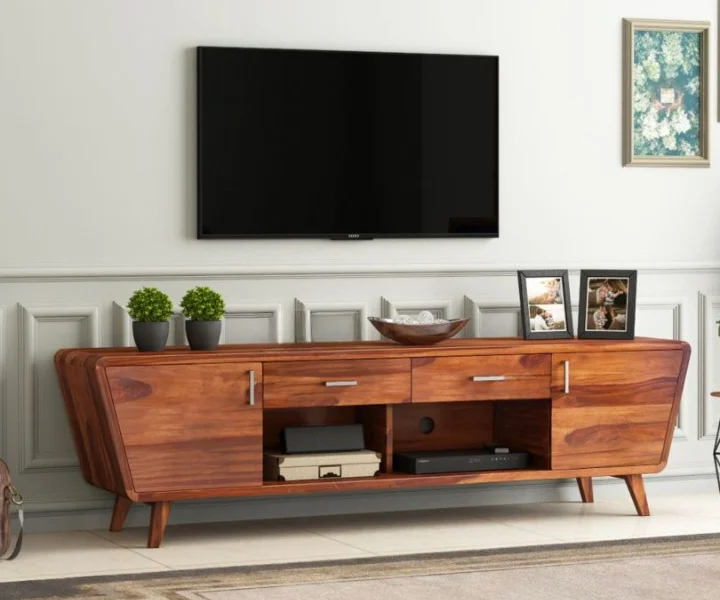
Sheesham Wood Tv Unit with Cupboards Drawers and Shelve Storage
Quick Storage Comparison
| Storage Type | Display Space | Hides Clutter | Airflow for Devices | Easy Dusting |
|---|---|---|---|---|
| Open shelves | High | Low | High | Low |
| Closed cabinets | Low | High | Low to medium | High |
| Drawers | Low | High | Medium | High |
| Mixed | Medium to high | Medium to high | Medium to high | Medium |
Our simple rule: if you can name five things you currently have no place for, choose a unit with closed storage. If your TV area is already tidy and you want a style statement, go with open shelves.
Size Compared: Getting the Measurements Right
A TV unit that is too small makes the television look like it is about to fall off. One that is too large swallows the room. Getting the size right is easier than it sounds if you follow a few basic rules.
Rule 1: The Unit Should Be Wider Than the TV
As a general guide, your TV unit should be at least as wide as the television, and ideally 15 to 30 centimetres wider on each side. This creates balance, gives the screen a stable look, and leaves room for a speaker or a decorative piece on either side.
Here is a rough guide based on common TV sizes. Always check your own television’s exact width in its manual, because brands vary slightly.
| TV Size | Approx. TV Width | Suggested TV Unit Width |
|---|---|---|
| 43 inch | 95 cm | 120 to 150 cm |
| 50 inch | 112 cm | 135 to 165 cm |
| 55 inch | 123 cm | 150 to 180 cm |
| 65 inch | 145 cm | 170 to 210 cm |
| 75 inch | 167 cm | 195 to 240 cm |
Rule 2: Think About Height
The centre of your screen should sit roughly at eye level when you are seated. For most sofas, that means the middle of the TV is about 90 to 110 centimetres from the floor. A very tall unit pushes the screen too high and strains your neck during long movie nights. If you want a lot of storage, choose a wide, low unit (also called a low-profile or console style) rather than a tall one.
Rule 3: Mind the Depth
Most TV units are 35 to 45 centimetres deep. That is enough for a soundbar, a set-top box and a gaming console. If you plan to place a TV on the unit rather than mounting it on the wall, make sure the stand or feet of the television fit comfortably within the top surface.
Rule 4: Check the Viewing Distance
A comfortable viewing distance is roughly 1.5 to 2.5 times the diagonal of the screen for a modern 4K television. In simple terms, a 55-inch TV works well from about 7 to 9 feet away. If your sofa is close to the wall, avoid oversized screens and bulky units that will crowd the space.
Rule 5: Measure the Room, Then Measure Again
Sketch the wall, mark windows and doors, and leave a gap for walking. Many people forget to measure the doorway and staircase the furniture has to pass through. A beautiful unit that cannot enter the house is a very expensive mistake.
Small Rooms vs Large Rooms
Small living room (under 150 sq ft): choose a floating or wall-mounted unit, or a slim console in a light colour. Lifting furniture off the floor makes the room feel bigger.
Medium living room: a 150 to 180 cm unit with mixed storage is the sweet spot.
Large living room: consider a full entertainment wall with side towers, a back panel and built-in lighting. Here you have room to make the TV wall a real feature.
Style Compared: Which Design Fits Your Home?
Now comes the fun part. Wooden TV units come in many styles, and the best one is the one that feels like your home. Here are the most popular modern designs and who they suit.
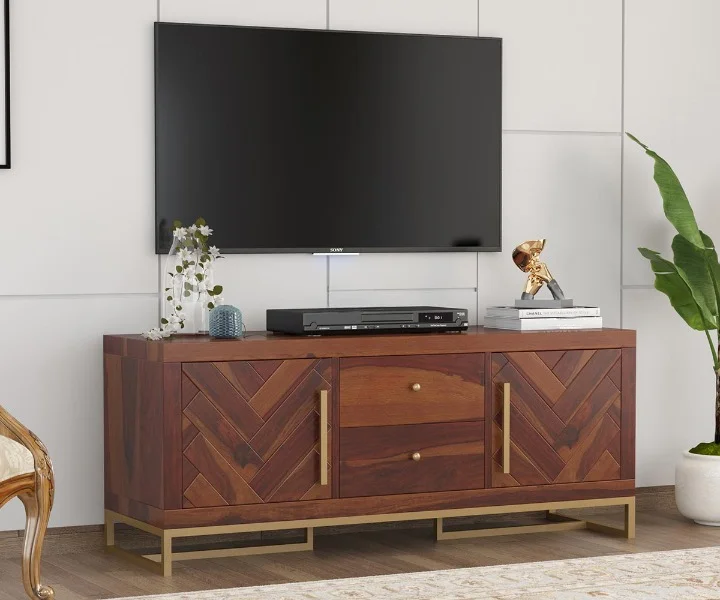
Floating (Wall-Mounted) TV Units
These units are fixed to the wall and appear to hover above the floor. They look sleek, make cleaning underneath easy, and create a light, spacious feel.
Pros: modern look, saves visual space, easy to mop under. Cons: needs a strong wall (brick or concrete, not thin partitions), installation must be done properly, and weight limits apply. Great for: apartments, small rooms, minimalist homes.
Low-Profile Console Units
A long, low unit with legs or a solid base. It is the classic modern choice and works with almost every room layout.
Pros: easy to move, no drilling required, plenty of surface area. Cons: takes floor space, and dust can collect beneath if there is no clearance. Great for: rented homes, families, anyone who may rearrange furniture later.
Entertainment Wall Units
These are large, full-wall designs with panels, shelves, cabinets and sometimes LED lighting. They turn the TV wall into the star of the room.
Pros: huge storage, dramatic look, hides wires neatly. Cons: higher cost, takes more installation time, and is harder to change later. Great for: large living rooms and homes where the TV wall is the focal point.
Corner TV Units
Designed to fit into a corner, these units save space in rooms with awkward layouts.
Pros: uses wasted corner space, good for compact rooms. Cons: limited storage and a narrower viewing angle from some seats. Great for: small rooms and bedrooms.
Fluted and Cane-Detail Units
Vertical fluting and woven cane panels are very popular right now. They add texture and a handcrafted feel, and cane doors let air and remote signals pass through.
Pros: trendy but warm, adds depth, helps ventilation. Cons: textured surfaces take a little more effort to dust. Great for: contemporary and boho-inspired homes.
Scandinavian and Minimal Units
Light wood tones, clean lines, slim legs and very little decoration. These units keep the focus on calm, open spaces.
Great for: small, bright rooms and people who like a quiet, uncluttered look.
Traditional and Carved Units
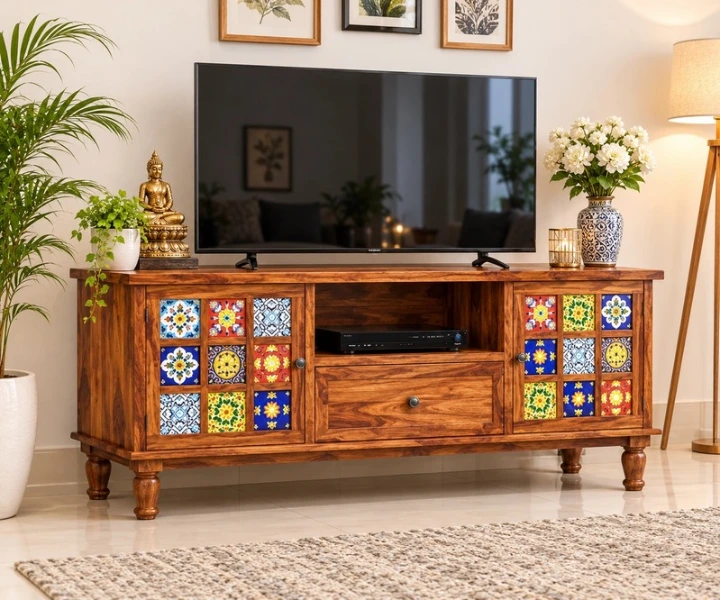
Deep wood tones, subtle carving and brass-style handles bring a heritage feel. They pair well with rich fabrics and classic Indian décor.
Great for: homes that lean towards a warm, timeless style.
Style Comparison at a Glance
| Style | Look and Feel | Storage Level | Best Room Size |
|---|---|---|---|
| Floating | Light, sleek | Low to medium | Small to medium |
| Low console | Balanced, versatile | Medium | Small to large |
| Entertainment wall | Bold, dramatic | High | Medium to large |
| Corner | Compact, practical | Low to medium | Small |
| Fluted or cane | Textured, trendy | Medium | Medium |
| Scandinavian | Calm, minimal | Low to medium | Small to medium |
| Traditional | Rich, classic | Medium to high | Medium to large |
Choosing the Wood: Solid, Plywood or MDF?
The material behind the design matters just as much as the design itself. Here is a plain-English comparison.
Solid wood (sheesham, teak, mango): Strong, long-lasting and repairable. It can be heavier and costs more, and it may react to extreme humidity if poorly seasoned. Sheesham is popular in India for its attractive grain and sturdy feel.
Plywood: Made of layered wood sheets, it resists warping better than many other engineered boards and holds screws well. Good-quality marine or BWP-grade plywood handles humid conditions better than standard grades.
MDF and particle board: Budget-friendly and smooth for painted or laminated finishes. They are more sensitive to moisture and heavy loads, so they suit light use and dry spaces better.
Our honest advice: if your budget allows, use solid wood or quality plywood for the main structure and shelves that hold heavy items. Ask the seller what the carcass, shelves and back panel are made of, and request it in writing.
Finishes That Look Good and Last
The finish affects both beauty and durability.
- Natural polish or melamine: shows off the grain and protects against everyday wear.
- PU (polyurethane) finish: smooth, resistant to stains and easy to wipe clean.
- Matte finish: hides fingerprints and looks modern, a good choice for busy homes.
- Veneer: a thin layer of real wood over a stable base, giving a premium look at a lower cost.
- Duco or painted finish: lets you match colours, though chips can be more visible over time.
If your living room gets strong afternoon sun, pick a finish with UV protection, or keep the unit away from direct light so the colour does not fade unevenly.
Smart Features Worth Paying For
A few small details can make living with a TV unit far more pleasant.
Cable management holes. Cut-outs at the back let wires pass through neatly. Without them, the back of your TV area becomes a spaghetti mess.
Ventilation. Electronics generate heat. Make sure there are gaps or slots so your set-top box, console and soundbar can breathe.
Soft-close hinges and drawers. They protect the furniture and reduce noise.
Built-in LED lighting. A soft strip of warm light behind or beneath the unit reduces eye strain in dark rooms and adds a premium touch.
Adjustable shelves. Your devices will change over the years. Shelves that move let the unit adapt.
Power outlets nearby. Plan your socket positions before the unit arrives so you do not end up with extension cords stretched across the floor.
Common Mistakes to Avoid
After years of seeing how people shop for furniture, these mistakes come up again and again.
- Buying only for looks. A gorgeous unit with no storage becomes frustrating in a month.
- Ignoring the TV’s weight and size. Always check the weight limit of the top surface or the wall-mount bracket.
- Forgetting airflow. Closed boxes trap heat, which can shorten the life of devices.
- Skipping wall checks. Floating units need a solid wall. Ask a qualified installer to check before drilling.
- Not planning for the future. You may upgrade from a 43-inch to a 65-inch screen. Choose a unit that can handle a bigger TV.
- Choosing the wrong colour contrast. A very dark unit against a dark wall can look heavy. A light unit against a pale wall can look washed out. Aim for gentle contrast.
- Overlooking delivery access. Measure doors, lifts and stairwells in advance.
How to Care for Your Wooden TV Unit
A little regular care keeps wood looking fresh for years.
- Dust weekly with a soft, dry microfibre cloth.
- Wipe spills straight away with a slightly damp cloth, then dry the surface.
- Avoid harsh chemical cleaners. A mild soap solution is usually enough.
- Use coasters and mats under décor items to prevent scratches and rings.
- Keep the unit away from leaking windows, damp walls and air-conditioner drips.
- During the rainy season, make sure the room has good airflow to limit moisture build-up.
- Tighten loose screws and hinges once or twice a year.
A Simple Buying Checklist
Before you pay for any TV unit, run through these questions.
- What is the exact width and weight of my TV?
- How much wall and floor space do I really have?
- What do I need to store: only a router and remote, or consoles, speakers and toys?
- Do I prefer open, closed or mixed storage?
- Is my wall strong enough for a floating unit?
- What wood and finish is used, and is it suitable for my climate?
- Does the unit have ventilation and cable management?
- What are the warranty and after-sales terms?
- Will it still fit my needs if I change my TV in a few years?
If you can answer most of these confidently, you are ready to shop.
Which Design Should You Choose? Quick Recommendations
For a small flat: a floating unit or slim low console with a couple of drawers in a light wood tone.
For a family with kids: a mixed-storage console with closed cabinets at the bottom and open shelves above, kept low for safety.
For a large living room: a full entertainment wall with side storage, a panel behind the TV and soft lighting.
For a rented home: a freestanding low console, because you can take it with you when you move.
For a traditional home: a warm-toned solid wood unit with simple carved details and brass-style handles.
For a modern, trendy look: a fluted or cane-detail unit with matte finish and hidden storage.
Frequently Asked Questions
What is the ideal size for a TV unit?
Your TV unit should be at least as wide as your television, and ideally 15 to 30 centimetres wider on each side. For a 55-inch TV, a unit between 150 and 180 centimetres wide usually looks balanced.
Is a wall-mounted TV unit better than a floor-standing one?
Neither is better for everyone. Wall-mounted units save floor space and look light, but need a strong wall and careful installation. Floor-standing units are easier to move and often hold more, making them a safer choice for rented homes.
Which wood is best for a TV unit in India?
Sheesham and teak are popular because they are sturdy and attractive. Good-quality plywood is also a reliable choice, especially in humid regions. The best option depends on your budget, climate and how heavy a load the unit will carry.
How much storage do I need in a TV unit?
List everything you want to keep there: set-top box, router, console, games, remotes, speakers and decorative items. If the list is long, choose closed cabinets or drawers. If it is short, open shelves are fine.
Can I put a TV on top of a wooden unit instead of mounting it?
Yes, as long as the top surface is wide and strong enough for the TV stand and its weight. Check that the TV’s feet sit fully on the surface with a safe margin at the edges.
How do I stop my devices from overheating inside a cabinet?
Choose a unit with ventilation slots, back cut-outs or cane panels, and leave a little space around each device. Avoid stuffing electronics tightly behind solid doors.
How do I clean and maintain a wooden TV unit?
Dust it weekly with a soft cloth, wipe spills quickly, avoid harsh chemicals and keep it away from moisture and direct sunlight.
Final Thoughts
The best TV unit is not the most expensive one or the one trending on social media. It is the one that matches your room size, handles your storage needs and fits your personal style. Start with the practical questions: how big is your TV, how much do you need to store, and how much space do you have? Then let style guide the final choice.
Wood gives you a wonderful starting point, offering warmth, strength and flexibility across every design from minimal floating units to grand entertainment walls. Take your measurements, check the build quality, and choose something you will be happy to see every single day.
If you are ready to explore options, browse the collection at Gadwal Furniture and compare designs with this guide in hand. A little planning now means a living room that looks beautiful and works smoothly for years to come.
Have a question about choosing the perfect TV unit? Leave it in the comments and we will be happy to help.
For more info, contact: support@gadwalfurniture.com
Follow our Instagram : Gadwal Furniture