Blog
How to Choose the Right Wardrobe for Your Bedroom: Complete Buying Guide (2026)

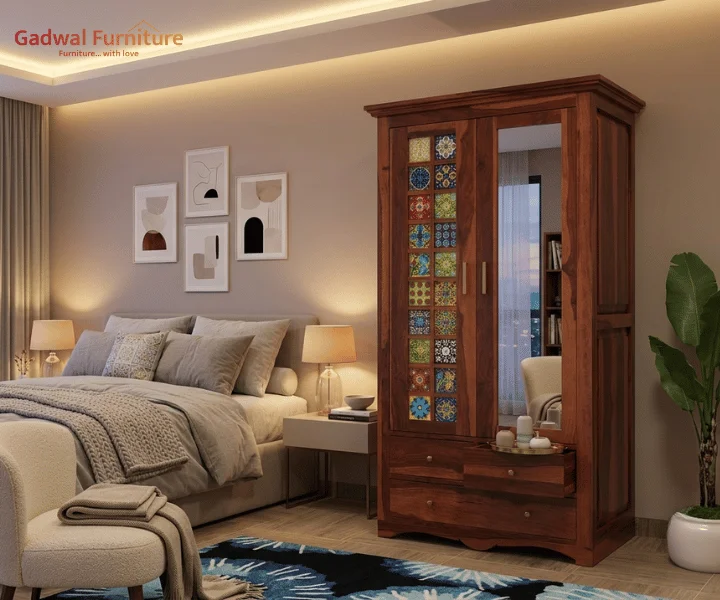
The right wardrobe for your bedroom is one that matches your room’s layout (sliding for tight spaces, hinged for larger rooms), is built from a material that won’t sag or swell over time, and leaves at least 30% of its internal space unplanned so you’re not fighting your own storage a year in. Get those three things right and everything else, organization, design, longevity, tends to fall into place.
If you’ve been scrolling through wardrobe options for the last hour and still don’t feel closer to an answer, that’s normal. It’s a bigger decision than it looks like on the surface, because a wardrobe isn’t just a box for clothes, it’s furniture you’ll open twice a day for the next fifteen-plus years. Worth getting right. Let’s walk through it properly.
Which Type of Wardrobe Is Best?
This is usually the first fork in the road, and honestly, there’s no universal “best”, it depends entirely on your room.
Sliding wardrobe doors are the go-to for smaller or narrower bedrooms because the doors run on a track instead of swinging outward and eating into your floor space. You can walk right up to them even with a bed pushed close by, which is why they’ve become the default recommendation for compact urban bedrooms. The trade-off is that you can only access one section at a time, the track needs occasional cleaning to stay smooth, and mirror-fronted sliding doors (a popular combination) need a bit more care during cleaning since you’re dealing with glass, not just wood.
Hinged (openable) wardrobes give you full, simultaneous access to everything inside, which makes daily use faster once you’re used to it. They need clearance to swing open, though, so they work best in rooms where you have at least 2.5–3 feet of open space in front of the unit.
Walk-in wardrobes are the dream scenario if you have a spare room or an oversized bedroom to dedicate to one. They’re less about “choosing a wardrobe” and more about custom-planning a small dressing room, shelving, hanging rods, drawers, sometimes a mirror station built in.
Modular wardrobes are worth a mention too, these are built in sections that can be added to or reconfigured later, which is genuinely useful if you’re not 100% sure of your final storage needs yet, or if you’re furnishing a home in stages.
If you’re short on space, sliding wins almost every time. If space isn’t the constraint, hinged is usually the more practical everyday choice, full visibility, no track maintenance, and generally a longer working life on the hardware.
How to Plan Your Wardrobe Space (The 70/30 Rule)
Here’s a mistake almost everyone makes: designing a wardrobe to hold exactly what they own right now. Your wardrobe needs breathing room, and the 70/30 rule is a simple way to build that in.
The idea is to plan for your wardrobe to be about 70% utilized and leave 30% flexible or unassigned. That 30% isn’t wasted space, it’s what absorbs new purchases, seasonal items, gifts, or that one bulky winter jacket you didn’t own last year. A wardrobe planned at 100% capacity from day one is a wardrobe that’s overflowing within twelve months, and once that happens, everything gets harder to find and clothes get more creased and crushed.
In practical terms, if you’re getting a wardrobe custom-built, ask your carpenter or furniture maker to leave one or two shelves and a hanging section genuinely open rather than assigning every inch to a specific purpose. It costs nothing extra and saves you a renovation two years down the line.
Choosing the Right Wardrobe Material
This is the decision that actually determines how long your wardrobe lasts, so it deserves more attention than it usually gets.
MDF (Medium-Density Fibreboard) is engineered from wood fibres and resin, pressed into sheets. It’s smooth, takes paint and laminate finishes well, and is generally the cheaper option upfront. The catch: MDF doesn’t handle moisture well. In humid Indian climates, especially during monsoon, MDF wardrobes are prone to swelling at the edges and around joints, and once that happens, doors stop closing flush and the damage isn’t really reversible.
Plywood is a step up, layers of wood veneer glued and pressed together, which gives it better moisture resistance and screw-holding strength than MDF. It’s a reasonable mid-range choice, though quality varies a lot between grades (BWP-grade marine plywood performs very differently from cheaper commercial-grade ply).
Solid wood is the most durable option by a clear margin, and it’s the one that actually improves with age instead of degrading. It handles humidity, temperature swings, and daily wear the way engineered boards simply can’t, because there’s no adhesive layer to break down and no fibreboard core to swell. It costs more upfront, but you’re not looking at a replacement in 6–8 years the way you often are with MDF.
At Gadwal, every wardrobe we make is 100% solid Sheesham wood, no MDF core, no particleboard shortcuts. Sheesham is naturally dense and termite-resistant to begin with, and we back that further with a lifetime warranty against termite and borer damage, which isn’t something you’ll find on engineered-wood furniture. If you’re comparing options and want to see the difference in person, our wardrobes collection has hinged 2-door and 3-door designs across a range of sizes and finishes.
So, MDF or plywood? If budget is the only constraint and you’re prepared to replace the piece within a decade, MDF works. If you want something built once and used for decades, plywood is better than MDF, and solid wood is better than both.
Wardrobe Design Mistakes to Avoid
A few patterns show up again and again in bedrooms that “just don’t feel like they have enough storage,” even when the wardrobe itself is large enough on paper.
Not measuring door clearance. A hinged wardrobe that can’t fully open because a bed or dresser is in the way effectively loses half its usable space.
Too much hanging space, not enough shelving. Most people’s wardrobes end up shelf-heavy in practice, folded clothes, bags, linens. Planning 60% hanging and 40% shelving usually backfires; it’s often closer to the reverse.
Skipping drawer inserts. An open shelf full of loose accessories, belts, and jewellery turns into a mess within a month. A few drawer units inside the wardrobe keep small items contained.
Ignoring room lighting. Deep wardrobes with no internal or ambient light near them make it hard to actually see what’s inside, especially darker wood tones in a dim corner.
Choosing a finish that clashes with the room. A heavy, dark wardrobe in a small room can visually shrink the space. Lighter Sheesham finishes tend to open up compact bedrooms far better than deep walnut or espresso tones.
Building for today’s wardrobe, not five years from now. Ties back to the 70/30 rule — plan a bit of slack in.
What Does Modern Wardrobe Design Look Like Right Now?
Wardrobe design has moved away from the heavy, dark, everything-behind-one-door units that dominated a decade ago. A few directions worth knowing before you pick a design:
Lighter, warmer wood tones over deep espresso or black finishes — they read as more modern and, practically, make a room feel bigger rather than smaller.
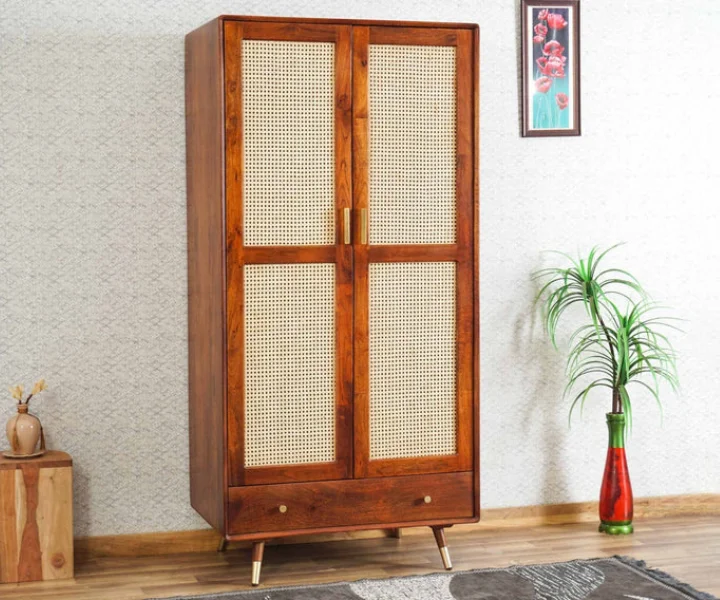
Mixed-material door panels — cane, rattan, or textured inserts set into a solid wood frame instead of a single flat wood panel. It’s less institutional-looking and adds texture without adding bulk.
Fewer visible handles — recessed or minimal hardware is the current look, cleaner sightlines rather than a row of pulls across the front.
Function built into the design, not bolted on after — internal drawer units, dedicated shoe or accessory sections, and shelving that’s planned at the design stage rather than added as an afterthought.
None of this is about chasing a trend that’ll look dated in two years — it’s really just a shift toward wardrobes that double as a piece of bedroom furniture you’d want visible, not something you’re trying to make disappear into a wall. The cane-panel and carved-detail designs mentioned further down (Scane, Maharaja) are good examples of this — a wardrobe as a design statement, not just storage.
How to Organize Your Wardrobe Efficiently (The 3-3-3 Rule)
Once you’ve got the right wardrobe, organizing what goes inside it doesn’t need to be complicated. The 3-3-3 rule is a simple mental model a lot of stylists and organizers use: divide your clothes into three categories
The 3 you wear on repeat — everyday essentials, kept front and centre, easiest to reach.
The 3 for specific occasions — formal wear, festive outfits, anything situational — stored a little further back or higher up since you’re not reaching for it daily.
The 3 you’re unsure about — items you haven’t worn in a while but aren’t ready to give away, boxed or shelved separately so they don’t clutter your daily rotation.
Applying this inside a well-planned wardrobe (sliding or hinged, with that 70/30 buffer built in) means everything has a logical “zone,” and you’re not digging through the whole unit every morning to find one shirt.
Which Wardrobe Should You Actually Buy?
Once you know your room’s clearance and roughly how much hanging vs. shelf space you need, it comes down to door count and design style. A few from our wardrobe that cover the most common scenarios:
- Solid Wood Two Door Wardrobe Wood Almirah in Rattan work for Bedroom — A compact 2-door design (90cm wide) with cane-panel detailing on the doors. Good fit for smaller or single-occupancy bedrooms where you want the wardrobe to double as a design feature, not just a storage box.
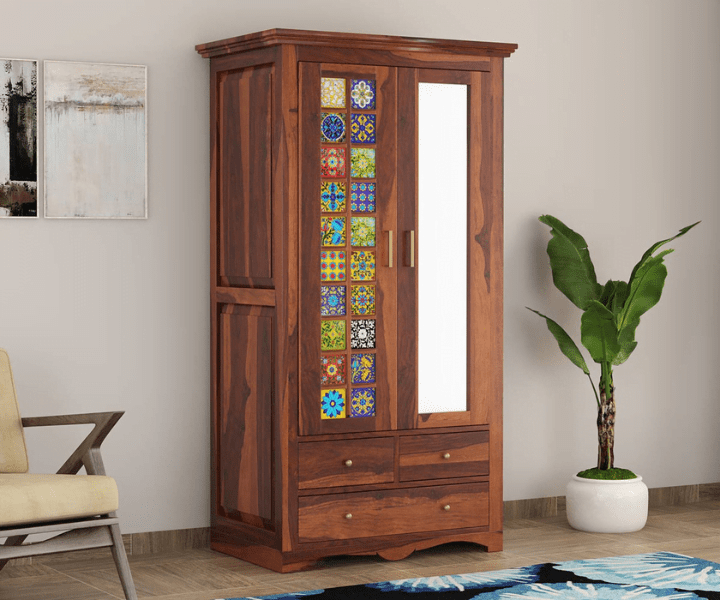
- Solid Wood 2 Door Multi Utility Wardrobe — A traditional 2-door silhouette and our most-reviewed wardrobe in this set. A safe, versatile pick if you want proven design rather than something experimental.
- Solid Wood Melody 3 Door Solid Sheesham Wood Wardrobe — Steps up to 3 doors for meaningfully more hanging and shelf space. Makes sense for shared bedrooms or anyone who knows two doors won’t leave the 30% buffer we talked about earlier.
- Solid Wood Edason Wooden Wardrobe — Carries the carved, traditional detailing of our Maharaja line. Suits bedrooms already leaning into a heritage or traditional design language, ideally paired with warmer, larger-room lighting so the detailing doesn’t get lost.
- Solid Wood Kayden 4 Door Multi Utility Wardrobe With Lock — Our largest option, built for spacious bedrooms or homes that want one substantial piece to anchor the room rather than multiple smaller units.
Every one of these is available in three finish options, so you’re not locked into one wood tone, worth keeping in mind if you’re worried about a heavy wardrobe visually shrinking a smaller room (see the design mistakes section above).
Whatever you choose, the material is the one decision you can’t easily undo later. A wardrobe you buy today should still be doing its job well past 2035, and that’s really only realistic with solid wood.
At Gadwal, every wardrobe is handcrafted from solid Sheesham wood, available in custom sizes to fit your exact room, backed by a lifetime termite and borer warranty, and shipped free across India. You can also see and feel the material quality firsthand at any of our showrooms before you buy. That’s a deliberate choice on our part, furniture this durable shouldn’t need a sales pitch, just an honest look at the wood.
Frequently Asked Questions
What is the 3-3-3 rule for clothes?
The 3-3-3 rule organizes your wardrobe into three groups: everyday essentials you wear constantly, occasion-specific items you reach for occasionally, and items you’re unsure about keeping. Grouping clothes this way makes daily dressing faster and keeps your wardrobe from feeling cluttered.
Which wardrobe is best for a bedroom?
Wardrobes with sliding doors suit smaller or narrower bedrooms since the doors run on a track and don’t need swing clearance. Hinged wardrobes work better in larger rooms and give full simultaneous access to everything inside. The “best” one depends on your room size and how much clearance you have in front of the unit.
What is the 70/30 rule for wardrobe?
The 70/30 rule means planning your wardrobe to be about 70% utilized, leaving 30% of the space unassigned for new purchases, seasonal items, and future needs — so the wardrobe doesn’t overflow within the first year or two.
How to choose the right wardrobe?
Start with your room layout (sliding for tight spaces, hinged for open ones), pick a durable material like solid wood over MDF or basic plywood, and plan the internal layout with the 70/30 rule so there’s room to grow.
Which is better for wardrobe, MDF or plywood?
Plywood generally outperforms MDF on moisture resistance and durability, especially in humid climates. Solid wood outperforms both, it doesn’t have an adhesive core or fibreboard base to swell or break down over time, so it lasts significantly longer.
What are common wardrobe design mistakes?
The most common ones are not checking door-swing clearance, over-allocating hanging space versus shelving, skipping drawer inserts for small items, poor lighting near the wardrobe, and designing for exactly what you own today instead of leaving room to grow.
For more info, contact: support@gadwalfurniture.com
Follow our Instagram : Gadwal Furniture